
AI crop yield forecasting: the AgriAI agent
The AgriAI Forecasting agent estimates how much and when you'll harvest and what each kilo costs, to plan labor, sales and deliveries.
Yield forecasting agent
Know how much you'll harvest, when, and at what cost.
What it does
- Estimates harvest quantity and date for each zone
- Updates the estimate daily with climate and growth
- Works out costs, water and energy per kilo
- Helps plan labor and picking
- Prepares data for sales, buyers and deliveries
- Compares seasons to do better next time
How it works, step by step
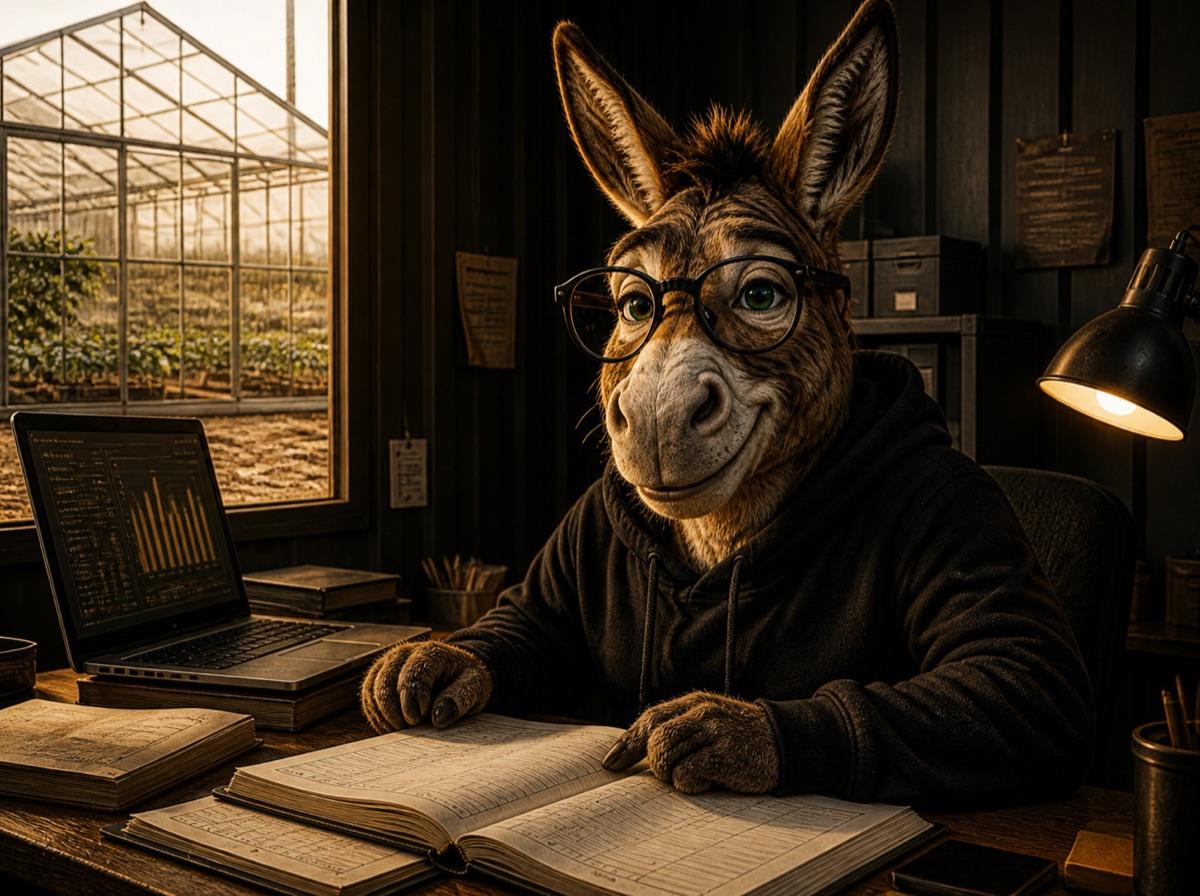
Gathers yield history, climate, growth and data from the other agents 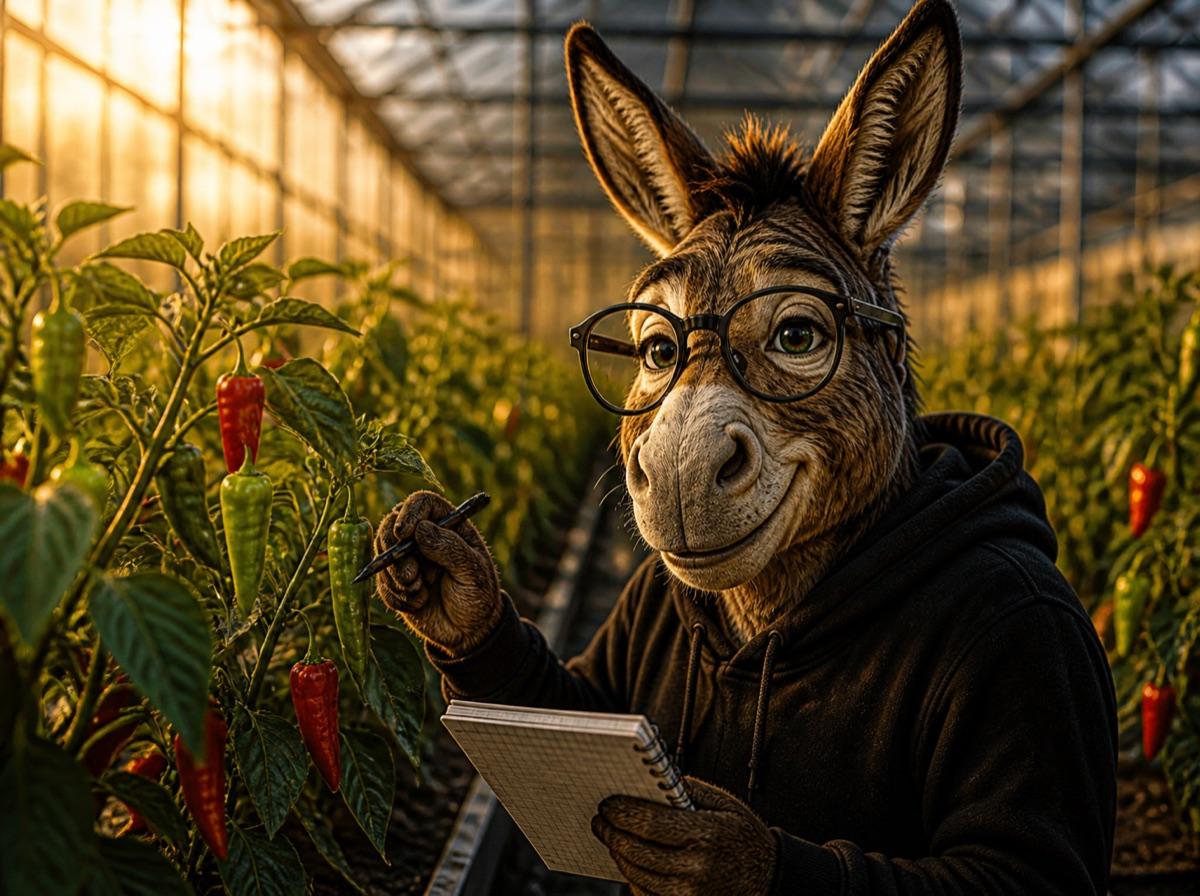
Estimates harvest quantity and date for each zone 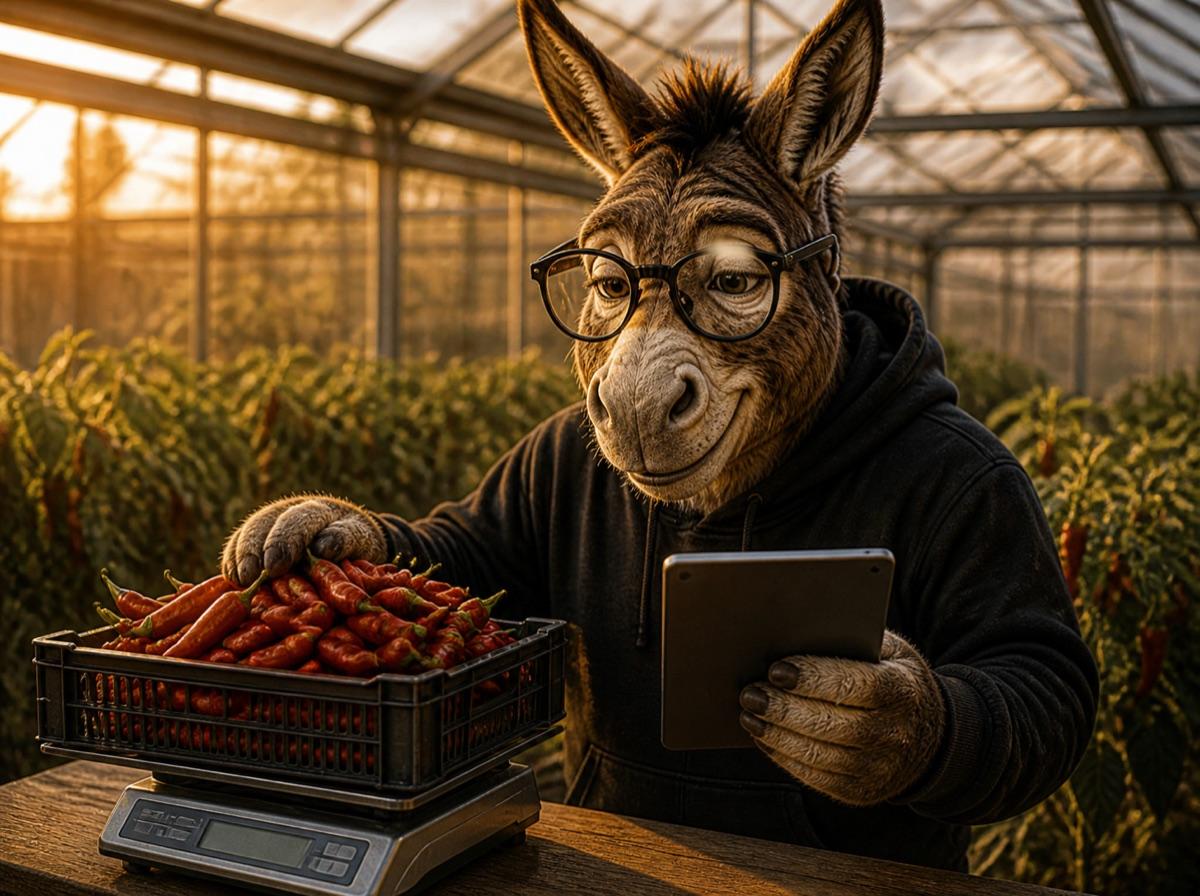
Updates the estimate daily and works out costs, water and energy per kilo 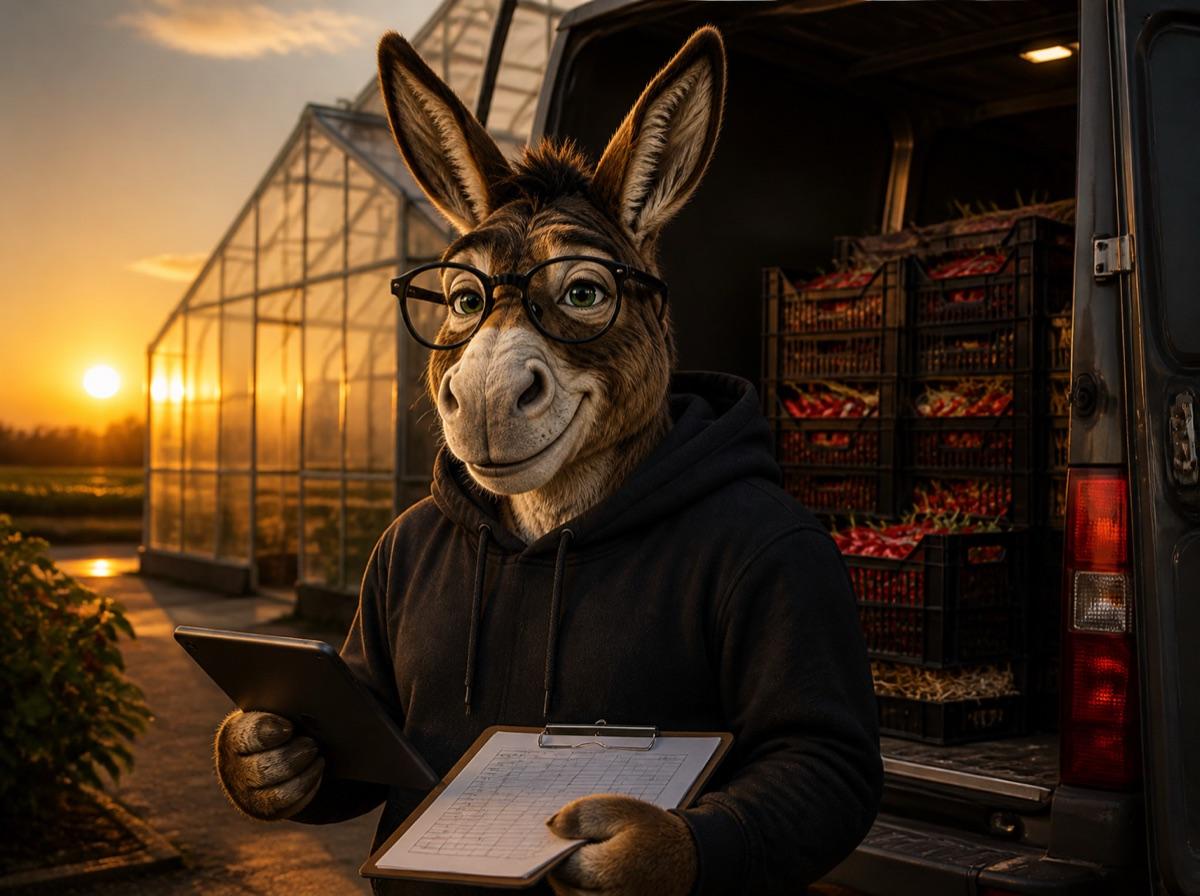
Prepares your picking plan and data for sales and deliveries
Agronomic deep dive
The science behind the agent
Forecasting yield means turning plant growth into numbers: how many fruits set, how long they take to ripen, how much they weigh. It is not a crystal ball, it is physiology applied to data, and it gets more accurate every week.
The plant counts heat
A crop's development depends on accumulated heat more than on calendar days. Growing degree days are used: each day you add how much the mean temperature exceeds a minimum threshold below which the plant barely grows, often set around 10 °C for pepper. From fruit set to harvest a certain sum of degree days is needed: if it is warmer, you get there sooner.
From light to kilos
The final quantity depends on the light intercepted by the leaves and on how the plant splits sugars between leaves and fruits. Pepper in particular alternates periods of heavy fruit set with periods when flowers drop, because the fruits already present absorb resources: a serious forecast must account for these waves.
How the agent reasons
The agent combines two approaches: a growth model based on degree days and light, which works even with little data, and a statistical model that learns from the individual farm's seasons. At first the former weighs more, later the latter. Every week it compares the estimate with the real harvest and corrects itself, and it always shows a range, not a single number.
The data needed and how to collect it
Representative sample plants are chosen and every week flowers, set fruits and growing fruits are counted, measuring some of them. At harvest everything is weighed per zone and split by size and commercial grade is recorded, because a kilo of first grade is not worth a kilo of rejects. It is a few minutes a week that make the forecast ten times more useful.
From physiology to machine learning
Growth models describe the crop with equations for intercepted light, photosynthesis and sugar partitioning: they work immediately but need calibrating to the variety. Statistical and machine learning models learn from the individual farm's data, but need history. A hybrid approach uses the former as a base and the latter to correct its systematic errors.
Every model is checked "in hindsight": you pretend it is the start of the season, forecast with the data available then and compare with what really happened. It is the honest way to know how far to trust a forecast before using it to sign a contract.
From forecast to decisions
A forecast is useful if it changes a decision: how many people to call in for picking and when, how much produce to commit to a buyer, how to organize transport and the cold chain. By combining the other agents' data, the agent also works out the cost of water, energy and fertilizer per kilo: the number that shows where the farm really makes money.
The limits to know
No model predicts a hailstorm, a system failure or a sudden outbreak. In the first year uncertainty is higher, because the model does not yet know the farm. That is why the agent always shows a range and updates it as soon as new data arrives: a forecast that states its limits is more useful than one that promises certainty.
The parameters that matter
| Parameter | Reference | Why it matters |
|---|---|---|
| Accumulated degree days | Daily sum above the crop threshold (for pepper often ~10 °C) | Estimate when fruits will be ripe |
| Fruits set per plant | Weekly count on sample plants | They are the harvest of the coming weeks |
| Average fruit weight | From harvest weighings, per variety | Turns fruit counts into kilos |
| Accumulated light | Weekly sum of radiation | Limits how many fruits the plant can bring to ripeness |
Reference values from the agronomic literature for soilless greenhouse vegetables: always calibrate them to crop, variety, stage and local climate.
The sensors it uses
What each one measures, where it goes and the detail that makes the difference. “Core” is needed to start, “Extra” adds precision. See the full list for all agents
- Substrate moisture probeCoreWater available in the substrate or soil (volumetric water content); many probes also read EC and temperatureIn the slab or soil, at root depth, on representative plants in every zoneUse several probes per zone: one reading describes one plant, not the greenhouse.
- Air temperature and humidity (aspirated box)CoreTemperature and relative humidity; VPD and dew point are worked out from themAt canopy height, in a shielded, aspirated box, at least one per compartmentWithout a shield and fan, sunlight can throw the reading off by several degrees.
- CO₂ sensor (NDIR infrared)CoreCarbon dioxide concentration in ppmIn the middle of the crop, away from doors and burnersCheck it regularly against outside air or a reference gas.
- PAR light sensorCoreLight useful for photosynthesis in µmol/m²/s and the daily totalAbove the crop, level and unshadedAccumulated light drives irrigation, CO₂ dosing and the growth estimate.
- Weather stationCoreTemperature, humidity, solar radiation, wind and rain outside the greenhouseOn top of or next to the greenhouse, clear of obstaclesWind and rain also matter for safety: closing vents before a storm.
- Weather forecastCoreExpected temperature, radiation and rain over the coming daysAn online data service: nothing to installThey let you act ahead instead of chasing, for example heating less before a sunny day.
- Fixed or trolley-mounted camerasCoreImages of the plants to spot symptoms and count flowers and fruitsOn a trolley running on the heating pipes, or at fixed pointsImages taken from the same spot at the same time are the easiest to compare.
- Field photos and notes (smartphone)CoreObservations by the people working in the greenhouse: symptoms, fruit counts, crop stagesFrom the AgriAI app, during the greenhouse walkThe grower's eye is still the most valuable sensor: the app turns it into data.
- Harvest weighingCoreKilos picked per zone and per dayA scale in the greenhouse or warehouse, linked to the platformWithout real harvest data the forecast cannot learn.
- Gutter scale (load cell)ExtraWeight of substrate and plants: water used and transpiration minute by minuteUnder a gutter with representative plantsIt is the most direct measure of water use and also shows plant growth over time.
- Satellite imagery (Sentinel-2)ExtraVegetation indices such as NDVI, mostly useful in open fieldsFree data from the EU Copernicus programme, updated every few days when skies are clearThey can't see inside a greenhouse; in open fields they show where the crop grows less.
- Dendrometer (stem sensor)ExtraChanges in stem diameter over the dayOn the stem of a few reference plantsThe stem shrinks by day and swells at night; if it doesn't recover, the plant is thirsty.
The most common mistakes
- Forecasting on calendar days instead of accumulated heat
- Trusting a single number with no margin of error
- Not weighing the harvest per zone: without real data the model cannot learn
- Ignoring the fruit-set waves typical of pepper
A useful forecast comes from physiology and measured data, always shows its uncertainty and improves with the seasons. That is how it becomes a tool for selling and planning work, not a promise.
Studies and sources
The scientific research and trade press we build on. Links go to the original sources.
Scientific research
- Predicting Sweet Pepper Yield Based on Fruit Counts at Multiple Ripeness Stages Monitored by an AI-Based System Mounted on a Pipe-Rail TrolleyHorticulturae (MDPI) · 2025Pepper yield forecasting in a commercial greenhouse by counting fruits at several ripeness stages with an AI system.
- Forecasting the Number of Harvest-ready Fruits of Sweet Peppers Using Multimodal Time-Series DataarXiv (preprint) · 2026Combines images and fruit counts over time and provides an uncertainty estimate. A preprint, not yet peer reviewed.
Frequently asked questions
25 questions, two answers each: the agronomist's and the developer's. When we cite an author, the link goes to the original work.
How does it estimate how much I'll produce?
The agronomist
Yield depends mainly on intercepted light and how efficiently the plant turns it into biomass, as John Monteith showed. Then what matters is how much of that biomass goes into fruit.
John L. Monteith, Climate and the efficiency of crop production in Britain, Philosophical Transactions of the Royal Society B, 1977The developer
We use a hybrid model: a physical part that follows physiology and a part learned from data that corrects the gap between forecast and reality. That keeps the model sensible even with little data.
What is a crop model?
The agronomist
It is a mathematical description of how the plant grows: photosynthesis, respiration, partitioning between leaves, stem and fruit. The Wageningen school, with C. T. de Wit and Jan Goudriaan, laid its foundations.
Jan Goudriaan, H. H. van Laar, Modelling Potential Crop Growth Processes, Kluwer, 1994The developer
For us it is code with parameters, under version control: every parameter change has an author, date and reason, and you can always roll back and rerun a past forecast.
Martin Kleppmann, Designing Data-Intensive Applications, O'Reilly, 2017Why count fruit with cameras?
The agronomist
Fruit set today is the harvest of the coming weeks. Counting by ripeness stage gives the most direct forecast, and it is the method followed by recent studies on pepper in commercial greenhouses.
The developer
An object-detection model from the YOLO family finds the fruit in each image; a tracking algorithm avoids counting the same fruit twice from different angles.
Joseph Redmon, Santosh Divvala, Ross Girshick, Ali Farhadi, You Only Look Once: Unified, Real-Time Object Detection, CVPR, 2016What are degree days?
The agronomist
Fruit development depends on temperature accumulated above a base threshold, around 10 °C for pepper. Summing degree days estimates when the fruit will be ripe.
Leo Marcelis, Ep Heuvelink, Jan Goudriaan, Modelling biomass production and yield of horticultural crops: a review, Scientia Horticulturae, 1998The developer
The agent adds measured degree days to those forecast by the weather service and projects the picking date for each fruit cohort. If the forecast changes, the date updates itself.
How accurate is the forecast?
The agronomist
It improves with data: less accurate in the first year, then it learns from the farm's seasons. For work planning the week-by-week trend is often enough.
The developer
Accuracy is measured as the mean percentage error on past forecasts, as Hyndman and Athanasopoulos teach. We will publish the accuracy measured at the Farm Tech, not a desk estimate.
Rob J. Hyndman, George Athanasopoulos, Forecasting: Principles and Practice, OTexts, 3rd ed., 2021Why a range and not an exact number?
The agronomist
To organise labour and deliveries you need the worst and best case, not just the average. A single number gives false confidence.
The developer
The forecast is probabilistic: a central value and a range with its probability. To estimate uncertainty we use model ensembles, a technique also studied at DeepMind.
Balaji Lakshminarayanan, Alexander Pritzel, Charles Blundell (DeepMind), Simple and Scalable Predictive Uncertainty Estimation using Deep Ensembles, NeurIPS, 2017What is backtesting?
The agronomist
It is like asking the model: if you had been here last year, what would you have forecast? Then comparing with what was actually picked.
The developer
Forecasts are rerun on the past using only data available at that moment, never later data. It is time-series cross-validation as described by Hyndman and Athanasopoulos.
Rob J. Hyndman, George Athanasopoulos, Forecasting: Principles and Practice, OTexts, 3rd ed., 2021Physical models or machine learning?
The agronomist
Physical models hold decades of knowledge about physiology: the review by Marcelis, Heuvelink and Goudriaan shows how mature they are for horticultural crops.
Leo Marcelis, Ep Heuvelink, Jan Goudriaan, Modelling biomass production and yield of horticultural crops: a review, Scientia Horticulturae, 1998The developer
In "The Bitter Lesson" Richard Sutton observes that in the long run general methods that scale with data win. But one farm has little data: that is why we combine physical structure with learning.
Richard S. Sutton, The Bitter Lesson, 2019Do you use neural networks for time series?
The agronomist
For the agronomist what matters is that the forecast follows the crop's course and reacts to events such as a heatwave or pruning.
The developer
Where there is enough data, yes: networks such as Hochreiter and Schmidhuber's LSTMs remember what happened weeks earlier, useful for a crop that responds to climate with a delay. But they are always compared against simpler models.
Sepp Hochreiter, Jürgen Schmidhuber, Long Short-Term Memory, Neural Computation, 1997Does it work in the first year, without history?
The agronomist
Yes, starting from literature parameters for the crop and variety. Reference books, such as the one edited by Ep Heuvelink on tomato, give solid starting values.
Ep Heuvelink (ed.), Tomatoes, CABI, 2018The developer
In the first year the physical part carries most of the weight and the learned part little; as data accumulate the balance shifts. The stated uncertainty is wider at the start, as it should be.
Does it use data from the other agents?
The agronomist
Yes, because climate, irrigation and plant health explain much of the variation in yield. A cold week or a thrips outbreak shows up in the harvest weeks later.
The developer
The agents share data through an event-based platform: each publishes what it measures and decides, and the forecast reads them. It is the architecture Martin Kleppmann describes for data-intensive systems.
Martin Kleppmann, Designing Data-Intensive Applications, O'Reilly, 2017Who is the forecast for?
The agronomist
To whoever organises picking and labour, sales, and packaging and transport. Knowing output two weeks ahead changes how you work.
The developer
The forecast exports to your management software and, if you wish, to customers through a standard interface. You decide what to share and with whom.
Does it forecast fruit size too?
The agronomist
Size depends on fruit load and available light: with too many fruits each stays smaller. It is a balance horticulture textbooks describe well.
Ep Heuvelink (ed.), Tomatoes, CABI, 2018The developer
Images give the size of each fruit and so the size distribution. That helps forecast not just kilos but how many will fall in each commercial grade.
What happens in a heatwave?
The agronomist
In very high temperatures pepper can drop flowers and young fruit, and the dip shows in the harvest weeks later. High temperatures also reduce pollen quality.
Hamlyn G. Jones, Plants and Microclimate, Cambridge University Press, 2013The developer
The agent simulates several scenarios: with and without a heatwave, at different intensities. That shows in advance how much output could fall, so you can warn customers in time.
Where does it get it wrong most often?
The agronomist
When something happens that the data don't record: an unreported disease, unusual pruning, a change of variety.
The developer
It is data drift: the world changes and the model doesn't know. Sculley and colleagues point to it as one of the hidden costs of machine learning; we monitor it and flag when conditions move outside known ones.
D. Sculley et al. (Google), Hidden Technical Debt in Machine Learning Systems, NeurIPS, 2015Why is weighing the harvest essential?
The agronomist
The real weight picked per zone is the ground truth everything else is measured against. Without it, you don't even know if the forecast was right.
The developer
In supervised learning the model learns by comparing forecast and real outcome. Without harvest data, as Goodfellow, Bengio and Courville explain, there is nothing to learn from.
Ian Goodfellow, Yoshua Bengio, Aaron Courville, Deep Learning, MIT Press, 2016How often is it updated?
The agronomist
For planning picking and sales a weekly update is enough; in peak weeks it pays to follow it daily.
The developer
It runs every day with the new climate, image and harvest data. Every version of the forecast is kept, so you can see how it changed and why.
Does it forecast market prices too?
The agronomist
No. Prices depend on factors outside the farm's control; knowing well how much and when you will produce is already a strong advantage in negotiations.
The developer
It is a deliberate scope limit: a model that promises too much loses credibility. We focus on what we can measure and verify in the greenhouse.
George E. P. Box, Science and Statistics, Journal of the American Statistical Association, 1976What about open fields?
The agronomist
In the field weather and soil weigh more, and variability between plots is greater. Satellite vegetation indices help show where the crop grows less.
The developer
We use free Sentinel-2 imagery from the EU Copernicus programme, at up to 10-metre resolution, combined with weather and weighing data. Clouds leave gaps in the data that the model must handle.
Can I trust a forecast I don't understand?
The agronomist
No, and you shouldn't. A good forecast is explained with agronomic facts: fruit set, forecast light, temperature.
The developer
Every forecast shows which factors moved it up or down. Cynthia Rudin argues that when decisions matter, interpretable models should be preferred over black boxes: that is our rule.
Cynthia Rudin, Stop explaining black box machine learning models for high stakes decisions and use interpretable models instead, Nature Machine Intelligence, 2019What are the stated limits?
The agronomist
They are the conditions in which the forecast isn't reliable: new varieties, extreme events, missing data. Knowing them in advance prevents bad decisions.
The developer
Every forecast carries the relevant caveats. As George Box wrote, all models are approximations: stating where ours fails is part of the scientific method.
George E. P. Box, Science and Statistics, Journal of the American Statistical Association, 1976Is there a digital twin of the crop?
The agronomist
Yes: a model that simulates the plant day by day. In Wageningen's autonomous greenhouse trials, simulations like this helped teams decide their growing strategy.
Silke Hemming et al. (Wageningen), Remote Control of Greenhouse Vegetable Production with Artificial Intelligence, Sensors, 2019The developer
The twin is updated with real measurements so it doesn't drift from the greenhouse, using estimation techniques such as the Kalman filter. That lets you try decisions on the model before applying them to plants.
Rudolf E. Kálmán, A New Approach to Linear Filtering and Prediction Problems, Journal of Basic Engineering, 1960What about fruit hidden by leaves?
The agronomist
Some fruit is never visible from a single angle. Manual counts on sample plants remain the reference for correcting.
The developer
The model learns a correction factor by comparing fruit seen by the camera with manual counts on the same plants. The factor is recalculated when the crop stage changes.
What is a good forecast worth economically?
The agronomist
It cuts wasted labour hours, unsold produce and penalties for missed deliveries. The value depends on the farm and its contracts.
The developer
We don't promise figures: with the pilot farm we measure planned and actual work hours, unsold produce and on-time deliveries, before and after using the agent.
Does it integrate with my customers' systems?
The agronomist
Large retailers increasingly ask for precise supply forecasts. Providing them reliably strengthens the business relationship.
The developer
We export in standard formats and through documented APIs; only the data you authorise are shared, with logged access.
European Union, General Data Protection Regulation (EU) 2016/679, EUR-LexThe other AgriAI agents
 Nursery agentHealthy, even seedlings, from seed to transplant.
 Transplant agentEvery seedling in the right place, at the right time.
 Fertigation agentThe right water and nutrients, at the right time.
 Climate agentThe greenhouse always in the ideal climate, with less energy.
 Crop protection agentSpots problems before they become damage.
 Harvest agentOnly ripe fruit, picked without damage.
 Quality agentEvery fruit in the right grade.
 Packing agentCorrect, traceable packs, from greenhouse to shelf.
Become a pilot farm
Free digital check-up: we look at systems, consumption and problems and tell you whether and where AgriAI can help.