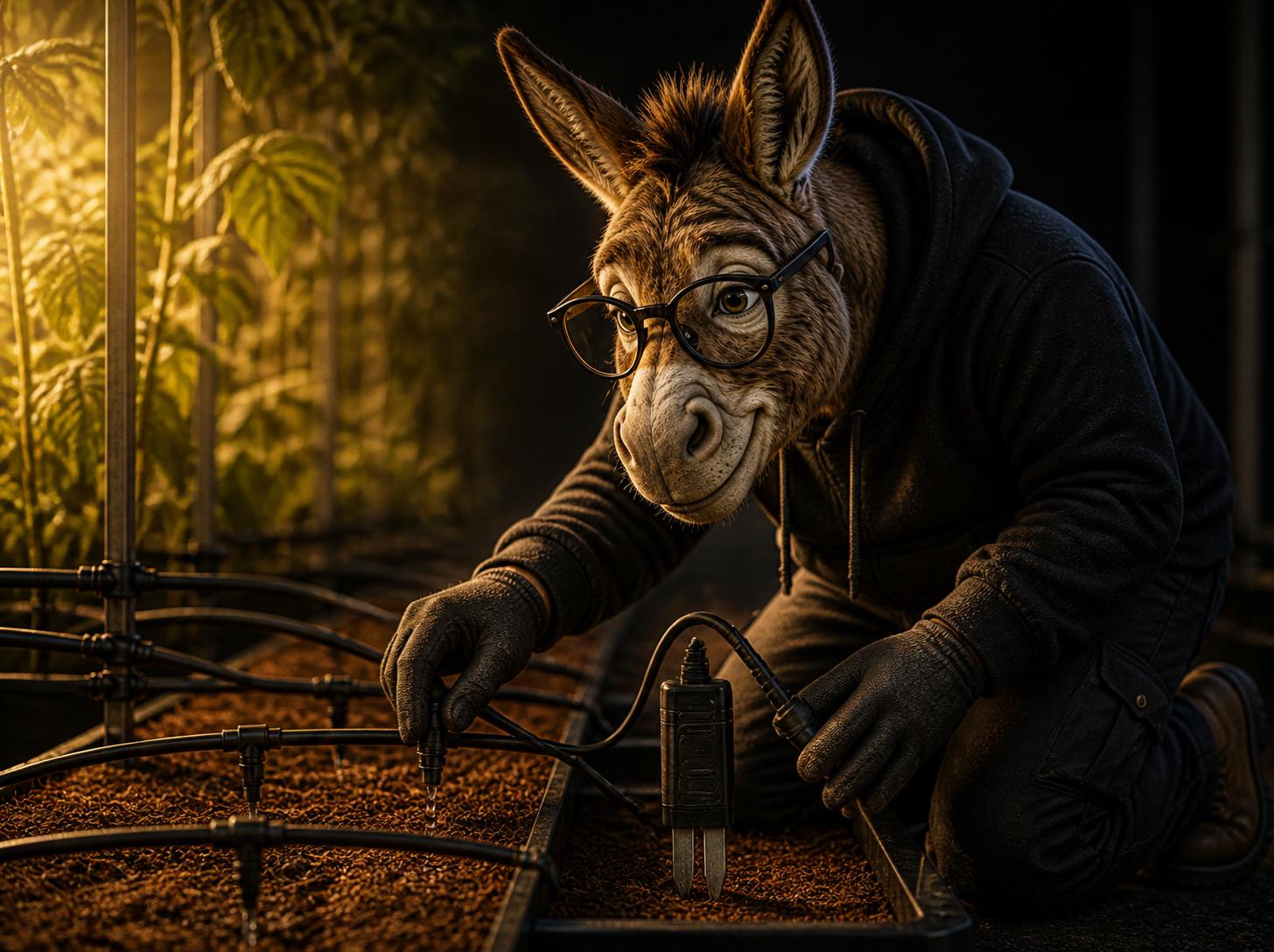
AI-driven automatic fertigation: how the AgriAI agent works
Sensor-driven automatic fertigation: the AgriAI agent decides when and how much to irrigate and doses nutrients, within limits you set.
Fertigation agent
The right water and nutrients, at the right time.
What it does
- Reads moisture, conductivity (EC) and pH of the substrate or soil
- Decides when and how much to irrigate, zone by zone
- Doses nutrients for the crop's growth stage
- Takes the day's weather and evaporation into account
- Flags leaks, clogged drippers and unusual consumption
- Logs the water and fertilizer used, ready for inspections
How it works, step by step
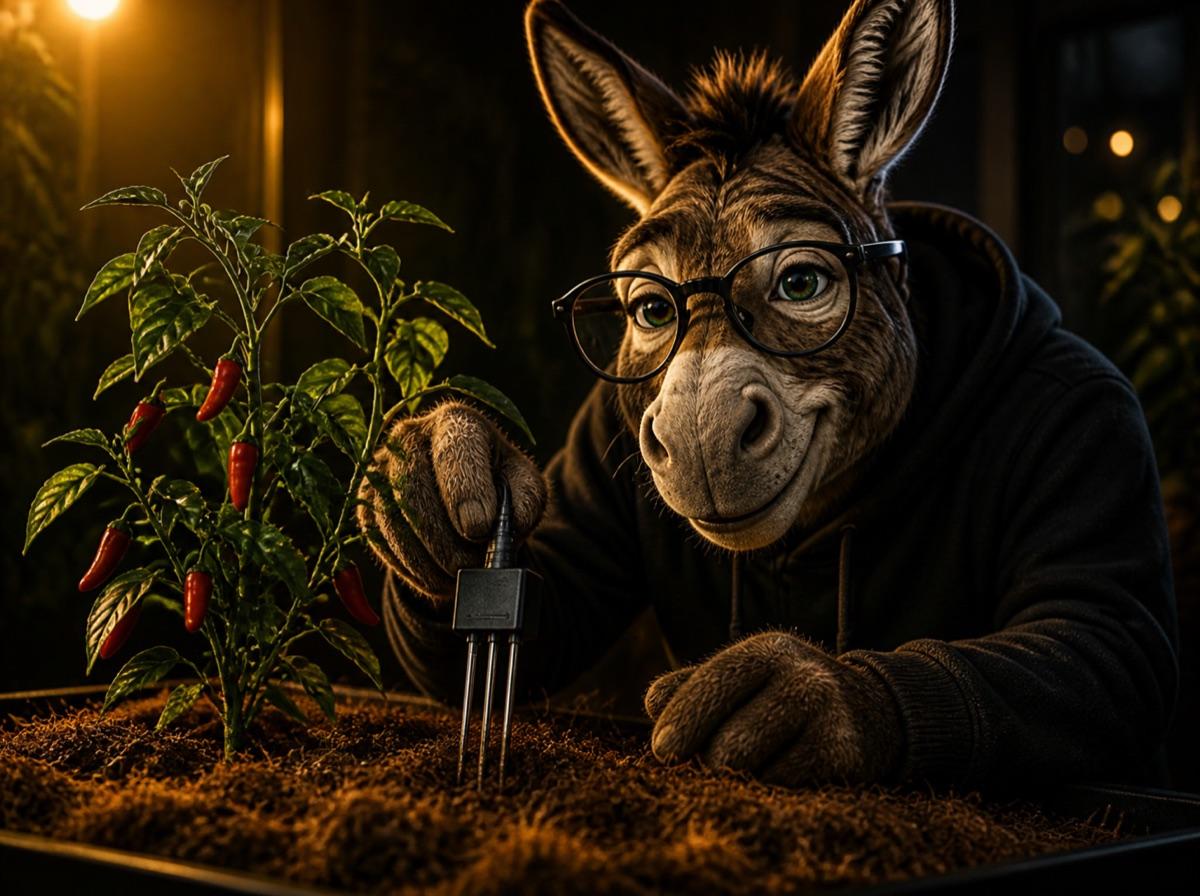
Sensors measure substrate moisture, EC and pH in every zone 
The agent compares readings with the crop recipe and the day's weather 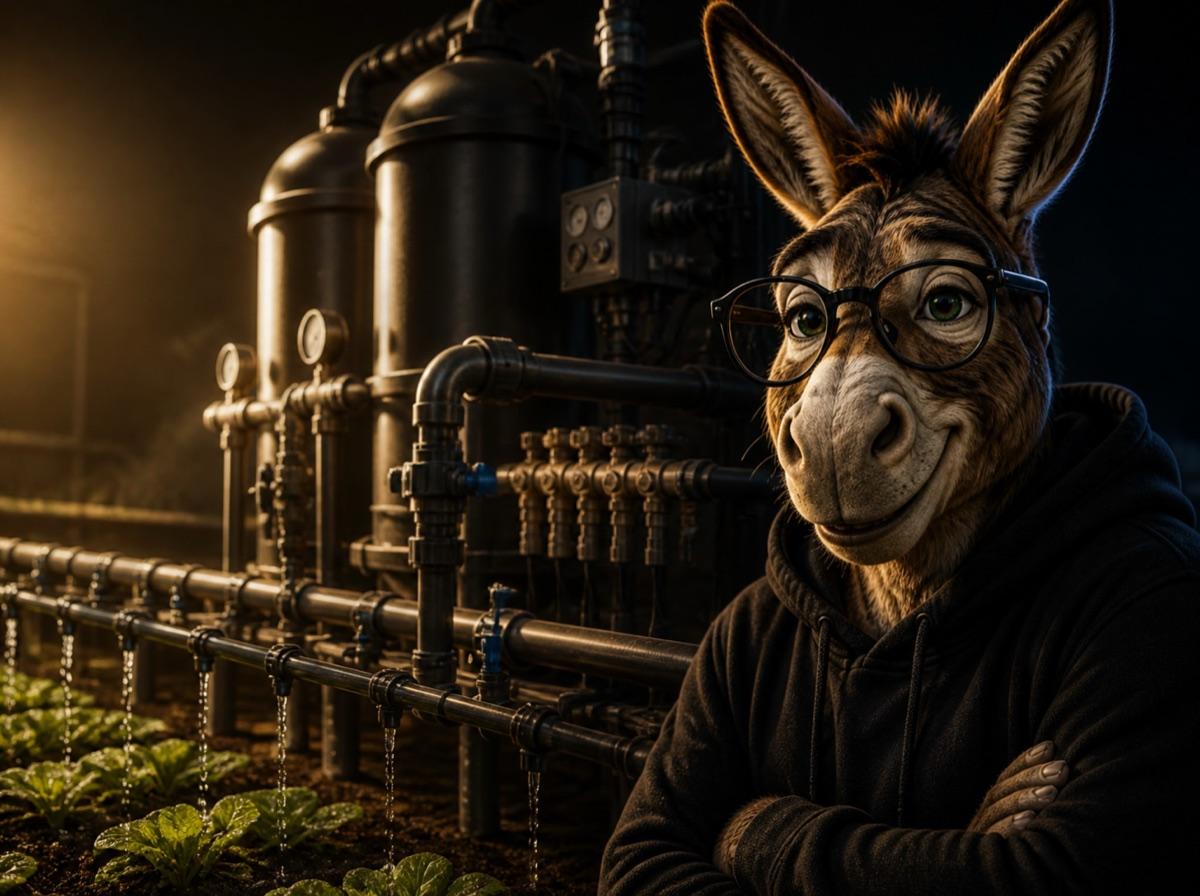
If needed, it starts irrigation with the right nutrient dose, within limits 
It logs what it did and why, and alerts you if something is off
Agronomic deep dive
The science behind the agent
Fertigation is not "water with fertilizer in it". It is managing the root zone as a small ecosystem: water, oxygen, salts and temperature must stay in balance, hour by hour, while the plant's demand changes with light and growth stage.
What happens in the root zone
Plants take up water mainly to transpire, and transpiration is driven largely by solar radiation: that is why, in a greenhouse, water demand follows light far more than the clock. Irrigating on a fixed timer means giving too much on overcast days and too little on clear ones.
In soilless growing the substrate has little volume and little buffer: water and salts change quickly. Roots also need oxygen, so a constantly saturated substrate is as harmful as one that is too dry. The aim is a regular cycle of wetting and slight drying.
Why drainage is measured
In soilless growing you deliberately irrigate slightly more than needed, so part of the solution drains and flushes excess salts. Comparing the EC of the solution going in with that coming out tells you whether salts are building up: if drainage is much saltier than the input, the plant is drinking water faster than it takes up nutrients.
How the agent reasons
The agent does not replace the agronomist's nutrient recipe: it applies it better. It times irrigation by combining accumulated radiation, substrate moisture and drainage percentage; it adjusts the dose within set limits and, if drainage EC or pH go out of range, it does not improvise: it flags and proposes, because changing the recipe is an agronomic decision.
Sensors: which to use and where to put them
In soilless growing the most reliable method is measuring drainage: a collection gutter with a flow meter and EC and pH probes tells you how much water the plants really left and how salty it is. Even more precise is continuously weighing a gutter of plants, which shows water use minute by minute. Substrate moisture probes complete the picture, but should be read as a trend, not an absolute value.
Placement matters: representative plants, away from row ends, doors and edges, where the climate differs. A single probe per zone is an opinion, not data: you need at least two or three to tell whether an odd reading is the plant or the sensor.
Source water and the nutrient recipe
It all starts with a water analysis. Bicarbonates raise pH and are neutralized with acid; sodium and chloride are not taken up and build up in the substrate, so they limit how much can be recirculated. The recipe is written in millimoles per liter of each element: the macros (nitrogen, phosphorus, potassium, calcium, magnesium, sulfur) and the micros (iron, manganese, zinc, boron, copper, molybdenum).
The recipe is not fixed for the whole season: with a heavy fruit load the plant asks for more potassium relative to calcium, while during strong vegetative growth nitrogen matters more. A periodic lab analysis of drainage shows whether an element is building up or running out before symptoms appear.
Recirculation and sustainability
In closed systems drainage is not thrown away: it is collected, disinfected (for example with UV or heat) so as not to spread root pathogens, corrected and reused. Water and fertilizer are saved and nitrate release into the environment is reduced, an issue European rules pay increasing attention to. The limit is sodium build-up: when it exceeds the crop's tolerance, part must be discharged.
How it works with the other agents
The Climate agent passes it radiation and VPD, which anticipate how much water will be needed in the next hours. The Crop protection agent flags root-related symptoms: an overly wet substrate favors root rot. The Forecasting agent uses its data to work out how much water and fertilizer each harvested kilo needs.
The parameters that matter
| Parameter | Reference | Why it matters |
|---|---|---|
| Input solution EC | Roughly 2.0–3.0 mS/cm for pepper, depending on stage and climate | How much nutrient salt the plant receives |
| Solution pH | Around 5.5–6.5 in soilless growing | Outside this range some nutrients (iron, phosphorus, manganese) become less available |
| Drainage percentage | Often 20–30% of the water applied during daylight | Prevents salt build-up without wasting water |
| Substrate moisture | To calibrate per substrate and crop: the daily curve matters most | Shows when the plant has used enough water to need another cycle |
| Accumulated solar radiation | Irrigation is triggered by accumulated light rather than by the clock | It is the main driver of transpiration |
Reference values from the agronomic literature for soilless greenhouse vegetables: always calibrate them to crop, variety, stage and local climate.
The sensors it uses
What each one measures, where it goes and the detail that makes the difference. “Core” is needed to start, “Extra” adds precision. See the full list for all agents
- Substrate moisture probeCoreWater available in the substrate or soil (volumetric water content); many probes also read EC and temperatureIn the slab or soil, at root depth, on representative plants in every zoneUse several probes per zone: one reading describes one plant, not the greenhouse.
- Conductivity (EC) sensorCoreHow much salt is dissolved in the nutrient solution, in mS/cmIn line on the supply and in the collected drainageCheck it against a reference solution: a dirty probe reads wrong without raising any alarm.
- pH sensorCoreAcidity of the solution, which decides how available the nutrients stayIn line on the supply and, by sampling, in the drainageCalibrate it regularly with buffer solutions (pH 4 and 7); the electrode ages and must be replaced.
- Drainage meterCoreThe water leaving the slabs, to work out the drainage percentageDownstream of a reference gutter (tipping bucket or tank with a level sensor)Compared with the water supplied, it shows right away whether you are over- or under-watering.
- Water meter (flow meter)CoreLitres delivered per zone and per cycleOn every line or zone valveIf the litres don't match the opening times, a dripper is blocked or there is a leak.
- Lab analysis of water and drainageCoreIndividual elements (nitrate, potassium, calcium, magnesium, sodium, chloride…) that EC cannot tell apartSamples sent to a lab every few weeksIt isn't a sensor, but without it EC tells you how much salt there is, not which.
- PAR light sensorCoreLight useful for photosynthesis in µmol/m²/s and the daily totalAbove the crop, level and unshadedAccumulated light drives irrigation, CO₂ dosing and the growth estimate.
- Weather stationCoreTemperature, humidity, solar radiation, wind and rain outside the greenhouseOn top of or next to the greenhouse, clear of obstaclesWind and rain also matter for safety: closing vents before a storm.
- Weather forecastCoreExpected temperature, radiation and rain over the coming daysAn online data service: nothing to installThey let you act ahead instead of chasing, for example heating less before a sunny day.
- Gutter scale (load cell)ExtraWeight of substrate and plants: water used and transpiration minute by minuteUnder a gutter with representative plantsIt is the most direct measure of water use and also shows plant growth over time.
- Root-zone temperatureExtraTemperature of the solution and the substrateIn the slab and in the solution tankRoots that are too cold or too hot take up water and nutrients poorly.
- Line pressure sensorExtraSystem pressure during irrigationAfter the pump and filters, and at the end of the lineA sudden drop or rise points to leaks, dirty filters or blocked drippers.
- Tank level sensorExtraHow much stock solution, acid and water is left in the tanksIn every stock, acid and water tankStops the system from dosing from an empty tank.
- Infrared leaf thermometerExtraLeaf temperature, without contactAimed at the canopy, from above or the sideLeaves warmer than the air point to plants transpiring little: possible water stress.
- Satellite imagery (Sentinel-2)ExtraVegetation indices such as NDVI, mostly useful in open fieldsFree data from the EU Copernicus programme, updated every few days when skies are clearThey can't see inside a greenhouse; in open fields they show where the crop grows less.
- Dendrometer (stem sensor)ExtraChanges in stem diameter over the dayOn the stem of a few reference plantsThe stem shrinks by day and swells at night; if it doesn't recover, the plant is thirsty.
The most common mistakes
- Always irrigating at the same times, whatever the weather
- Checking only input EC and never drainage EC
- Calibrating sensors once and forgetting them: EC and pH probes drift and need recalibration
- Not testing the source water: bicarbonates and sodium change the whole recipe
Good fertigation follows light, measures what comes out as well as what goes in, and leaves recipe decisions to the agronomist. That is exactly the pattern the agent follows.
Studies and sources
The scientific research and trade press we build on. Links go to the original sources.
Scientific research
- L'equilibrio nutrizionale del pomodoro: strategie tecniche di fertirrigazione efficiente e sostenibileRivista di Agraria · 2026Continuous EC and pH monitoring of input and drainage, using the EC difference as an indicator.
- Prova di fertirrigazione con drenaggio ridotto su fragola fuori suoloFondazione Edmund Mach · 2021Compares standard drainage around 20% with lower percentages and their effects on the crop.
- Soilless greenhouse sweet pepper: irrigation trial (Bonasia, Stanghellini, Abdel-Mawgoud)Wageningen University & Research · 2001Trial on pepper in rock wool with continuous logging of climate inside and outside the greenhouse.
From the trade press
- Serricoltura in Sicilia tra aeroponica e agrivoltaicoAgroNotizie · 2026Substrate sensors, controllers and a platform automating irrigation and nutrition in soilless growing.
- Pomodoro da industria: la fertirrigazione smart guida le produzioni in ItaliaAgroNotizie · 2025Connected controllers adjusting fertigation by flow, pressure, soil and climate.
Frequently asked questions
25 questions, two answers each: the agronomist's and the developer's. When we cite an author, the link goes to the original work.
How does the agent decide when to irrigate?
The agronomist
In soilless growing you irrigate mainly by accumulated light, because transpiration follows radiation, as described by the Penman-Monteith model adopted by FAO. Probes then confirm the substrate has dried to the target level.
Richard G. Allen, Luis S. Pereira, Dirk Raes, Martin Smith, Crop evapotranspiration (FAO Irrigation and Drainage Paper 56), FAO, 1998The developer
The agent combines three conditions: radiation accumulated since the last cycle, moisture from the probes and a minimum time between cycles. Every decision is stored with the data behind it, so you can always reconstruct why it irrigated.
Martin Kleppmann, Designing Data-Intensive Applications, O'Reilly, 2017How much water does each cycle give?
The agronomist
Small, frequent cycles keep the slab within a narrow band of moisture and EC. The right volume depends on the substrate (rock wool, coir, perlite) and the crop stage.
Michael Raviv, J. Heinrich Lieth, Asher Bar-Tal (eds.), Soilless Culture: Theory and Practice, Elsevier, 2019The developer
The volume per cycle has a minimum and maximum you set: the agent adjusts the number of cycles and volume only within those limits. Control theory calls it actuator saturation, and it is what keeps the system predictable.
Karl Johan Åström, Richard M. Murray, Feedback Systems: An Introduction for Scientists and Engineers, Princeton University PressWhy do you need a drainage percentage?
The agronomist
Drainage flushes out the salts that build up in the slab. Growers often work at 20–30%, depending on water quality and light: too little builds up salt, too much wastes water and fertiliser.
Cees Sonneveld, Wim Voogt, Plant Nutrition of Greenhouse Crops, Springer, 2009The developer
Measured drainage is the system's feedback signal: comparing litres supplied and litres collected, the agent corrects the next cycle. It is a feedback controller, with the same logic as a thermostat.
Karl Johan Åström, Richard M. Murray, Feedback Systems: An Introduction for Scientists and Engineers, Princeton University PressWhat EC should the solution have?
The agronomist
It depends on crop, stage and light. For soilless pepper growers often keep 2–3 mS/cm in the slab: with strong light it goes down to ease water uptake, with low light it can go up to improve fruit quality.
Cees Sonneveld, Wim Voogt, Plant Nutrition of Greenhouse Crops, Springer, 2009The developer
For the software the target EC is a curve over time, not a fixed number: the agent reads it from the crop plan, adjusts it for forecast light and logs every change with date and reason.
Why does pH matter so much?
The agronomist
Outside the 5.5–6.5 range some elements, such as iron, manganese and phosphorus, become less available to roots, and deficiencies appear even though the fertiliser is there.
Michael Raviv, J. Heinrich Lieth, Asher Bar-Tal (eds.), Soilless Culture: Theory and Practice, Elsevier, 2019The developer
Correcting pH means dosing acid into a system that reacts slowly. The agent uses small steps followed by waits, to avoid the oscillations typical of an over-aggressive controller.
Karl Johan Åström, Richard M. Murray, Feedback Systems: An Introduction for Scientists and Engineers, Princeton University PressDoes the agent also prepare the nutrient recipe?
The agronomist
The recipe starts from the water analysis: subtract what the water already holds and add the rest, as in the classic formulas descended from Hoagland and Arnon's solution. The law of the minimum still applies: the scarcest element sets the limit.
Dennis R. Hoagland, Daniel I. Arnon, The water-culture method for growing plants without soil, University of California, Circular 347, 1950The developer
For the software it is a constrained optimisation problem: available fertilisers, ion ratios, tank compatibility. The agent proposes a recipe and you approve it: nothing changes without your sign-off.
Why are two tanks, A and B, needed?
The agronomist
Because concentrated calcium precipitates with sulphates and phosphates into insoluble deposits. They are kept apart in the stock tanks and only meet once diluted in the irrigation water.
Cees Sonneveld, Wim Voogt, Plant Nutrition of Greenhouse Crops, Springer, 2009The developer
This rule is written into the code as a constraint: the software rejects any recipe that puts incompatible products in the same tank, instead of relying on the operator's memory.
Can drainage water be reused?
The agronomist
Yes, with disinfection (UV, heat or slow sand filters) and sodium control, since sodium builds up because plants take up little of it. Recirculation greatly reduces water and nutrients released into the environment.
Cecilia Stanghellini, Bert van 't Ooster, Ep Heuvelink, Greenhouse Horticulture: Technology for Optimal Crop Production, Wageningen Academic Publishers, 2019The developer
In recirculation the data become a mass balance: the agent estimates day by day how much sodium and chloride builds up and says when to discharge part of the solution, recalibrating at every lab analysis.
How is the plants' real water use measured?
The agronomist
The most direct method is to weigh a gutter of representative plants continuously: weight drops with transpiration and rises after each irrigation. That shows how much water the crop really uses.
Cecilia Stanghellini, Bert van 't Ooster, Ep Heuvelink, Greenhouse Horticulture: Technology for Optimal Crop Production, Wageningen Academic Publishers, 2019The developer
The scale signal is disturbed by wind, harvesting and crop work. It is filtered and events are separated with estimation techniques such as the Kalman filter, which combines measurement and model to get the most likely value.
Rudolf E. Kálmán, A New Approach to Linear Filtering and Prediction Problems, Journal of Basic Engineering, 1960Does it work in open fields too?
The agronomist
Yes, but the reference changes: you work with crop evapotranspiration, the reference value multiplied by a crop coefficient, and with soil water reserve, as in the FAO method.
Richard G. Allen, Luis S. Pereira, Dirk Raes, Martin Smith, Crop evapotranspiration (FAO Irrigation and Drainage Paper 56), FAO, 1998The developer
In the field the agent uses a weather station, forecasts, multi-depth probes and, where useful, Sentinel-2 satellite imagery. Uncertainty is higher than in a greenhouse, so thresholds are more cautious and alerts more frequent.
Can you save water without losing yield?
The agronomist
Studies on regulated deficit irrigation show that at some stages a slight cut in water costs little yield and can improve quality. It doesn't hold for every crop or stage: it has to be tested case by case.
Elías Fereres, María Auxiliadora Soriano, Deficit irrigation for reducing agricultural water use, Journal of Experimental Botany, 2007The developer
Savings can only be shown with a controlled comparison: one zone run by the agent and one reference zone, in the same greenhouse and season. Without a comparison, a savings figure proves nothing.
George E. P. Box, Science and Statistics, Journal of the American Statistical Association, 1976How many probes are needed per zone?
The agronomist
At least two or three per uniform zone, on representative plants, away from edges and faulty drippers. A single probe describes one plant, not the greenhouse.
Michael Raviv, J. Heinrich Lieth, Asher Bar-Tal (eds.), Soilless Culture: Theory and Practice, Elsevier, 2019The developer
With several probes the agent uses the median, which isn't fooled by one faulty sensor. The spread between probes becomes data too: if it grows, the system is distributing water unevenly.
Capacitive probes or tensiometers?
The agronomist
Capacitive probes measure how much water there is; tensiometers measure how tightly the substrate holds it, which is what the plant "feels". In soilless growing capacitive probes are more practical; in the field tensiometers remain very useful.
Hamlyn G. Jones, Plants and Microclimate, Cambridge University Press, 2013The developer
They are different signals with different calibrations. For each probe the system stores type, calibration and install date, so changing hardware doesn't corrupt the history: the classic problem of evolving data schemas.
Martin Kleppmann, Designing Data-Intensive Applications, O'Reilly, 2017How often should EC and pH sensors be calibrated?
The agronomist
pH with buffer solutions at pH 4 and 7, EC with a reference solution, at regular intervals and always cross-checked with a handheld meter. A dirty probe reads wrong without any sign.
Cees Sonneveld, Wim Voogt, Plant Nutrition of Greenhouse Crops, Springer, 2009The developer
The agent tracks due dates, logs the offset found at each calibration and flags a probe for replacement when drift grows too large. It is predictive maintenance applied to sensors.
Can you irrigate by reading the plant directly?
The agronomist
Yes, with stem dendrometers or leaf temperature: the plant signals stress before the substrate does. Hamlyn Jones described these indicators in depth; today they are mostly used in research and high-value crops.
Hamlyn G. Jones, Plants and Microclimate, Cambridge University Press, 2013The developer
These signals need cleaning: daily variation has to be separated from growth. Machine learning helps here, but only with several seasons of data; until then the agent uses them as confirmation, not as a trigger.
Ian Goodfellow, Yoshua Bengio, Aaron Courville, Deep Learning, MIT Press, 2016Does the agent use AI or fixed rules?
The agronomist
For the agronomist what matters is that every decision can be explained and fits plant physiology. A clear rule written by someone who knows the crop is often worth more than a prediction nobody can justify.
The developer
Both: agronomic rules provide the base and the limits, learned models handle forecasts such as tomorrow's water use. As Cynthia Rudin argues, when decisions matter you should prefer interpretable models.
Cynthia Rudin, Stop explaining black box machine learning models for high stakes decisions and use interpretable models instead, Nature Machine Intelligence, 2019Who is responsible if the agent gets it wrong?
The agronomist
Agronomic responsibility stays with the farm and its advisor. The agent works within limits they set, and anything outside those limits needs confirmation.
The developer
That is why every action goes into a log that cannot be altered, and the system is designed for the human oversight required by the EU AI Act.
European Union, Artificial Intelligence Act (EU) 2024/1689, EUR-LexWhat happens if a sensor fails?
The agronomist
A wrong reading can cause over- or under-watering, and in soilless growing roots have little reserve. That is why the agronomist always wants cross-checks between probes, drainage and how the plants look.
The developer
Every sensor goes through plausibility checks: out-of-range, frozen or jumping values. If a reading isn't credible the agent drops it, falls back to the fixed safety programme and alerts you: the system must fail safe.
Ross Anderson, Security Engineering, Wiley, 3rd ed., 2020Does it work if the internet goes down?
The agronomist
Irrigation can't stop because of a network problem: in summer, a few hours without water are enough to damage a soilless crop.
The developer
The on-farm controller carries on with the last valid programme. Data are stored locally and synced when the network returns, with nothing lost: the principle of fault-tolerant distributed systems.
Martin Kleppmann, Designing Data-Intensive Applications, O'Reilly, 2017Which protocols does it use to connect?
The agronomist
For the grower one thing matters: not having to replace a system that works. The connection adapts to the greenhouse, not the other way round.
The developer
We use open standards: Modbus for controllers, MQTT for networked sensors and LoRaWAN for distant battery sensors. MQTT was created in 1999 precisely to monitor plants over slow, unreliable links.
Andy Stanford-Clark, Arlen Nipper, MQTT, the IoT messaging protocol (1999), mqtt.orgWho owns my farm's data?
The agronomist
Field data are an asset: years of recipes, yields and variety responses are worth as much as the head grower's experience.
The developer
They stay yours, exportable in open formats at any time. Processing follows the GDPR, and your data aren't used to train models for other customers without your explicit consent.
European Union, General Data Protection Regulation (EU) 2016/679, EUR-LexHow do I know the agent is doing a good job?
The agronomist
With agronomic indicators: drainage in the target band, stable drainage EC, plants without stress signs and litres of water per kilo of produce going down.
The developer
A dashboard compares targets with measurements and alerts when the gap exceeds a threshold. It is the continuous monitoring that Sculley and colleagues at Google call essential for any machine learning system in production.
D. Sculley et al. (Google), Hidden Technical Debt in Machine Learning Systems, NeurIPS, 2015How much fertiliser is saved?
The agronomist
It depends on where you start. With recirculation and precise dosing the literature reports large cuts in discharged nutrients, but the real figure has to be measured on your farm.
Cecilia Stanghellini, Bert van 't Ooster, Ep Heuvelink, Greenhouse Horticulture: Technology for Optimal Crop Production, Wageningen Academic Publishers, 2019The developer
We don't promise percentages. The agent measures litres of water and grams of fertiliser per kilo produced before and after, so savings become verifiable data.
Do I have to replace my controller?
The agronomist
No, as long as it doses accurately and logs data reliably. A good controller remains the backbone of the system.
The developer
We connect through the interfaces the controller already has. If it has none, a small module reads the signals and writes only authorised setpoints: the agent suggests, the controller executes.
Karl Johan Åström, Richard M. Murray, Feedback Systems: An Introduction for Scientists and Engineers, Princeton University PressHow does it learn from past seasons?
The agronomist
Every season adds experience: how the variety responds, which recipes worked, what happened in the hottest weeks. It is what a good head grower does, written down.
The developer
The model is retrained at the end of each cycle on checked data, and a new version goes live only if it beats the previous one on past seasons. As statistician George Box reminded us, no model is true: what counts is how useful it is.
George E. P. Box, Science and Statistics, Journal of the American Statistical Association, 1976The other AgriAI agents
 Nursery agentHealthy, even seedlings, from seed to transplant.
 Transplant agentEvery seedling in the right place, at the right time.
 Climate agentThe greenhouse always in the ideal climate, with less energy.
 Crop protection agentSpots problems before they become damage.
 Harvest agentOnly ripe fruit, picked without damage.
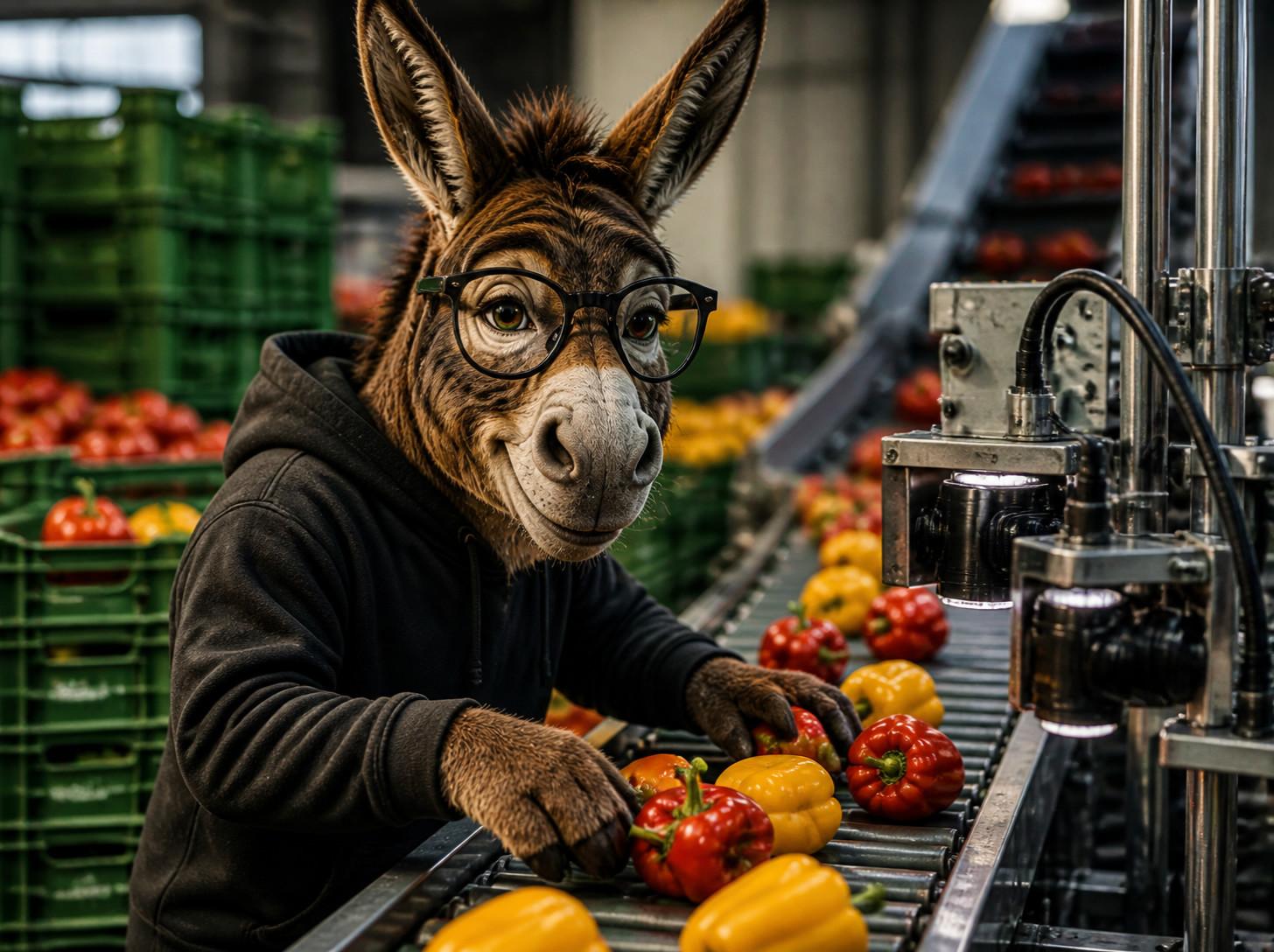 Quality agentEvery fruit in the right grade.
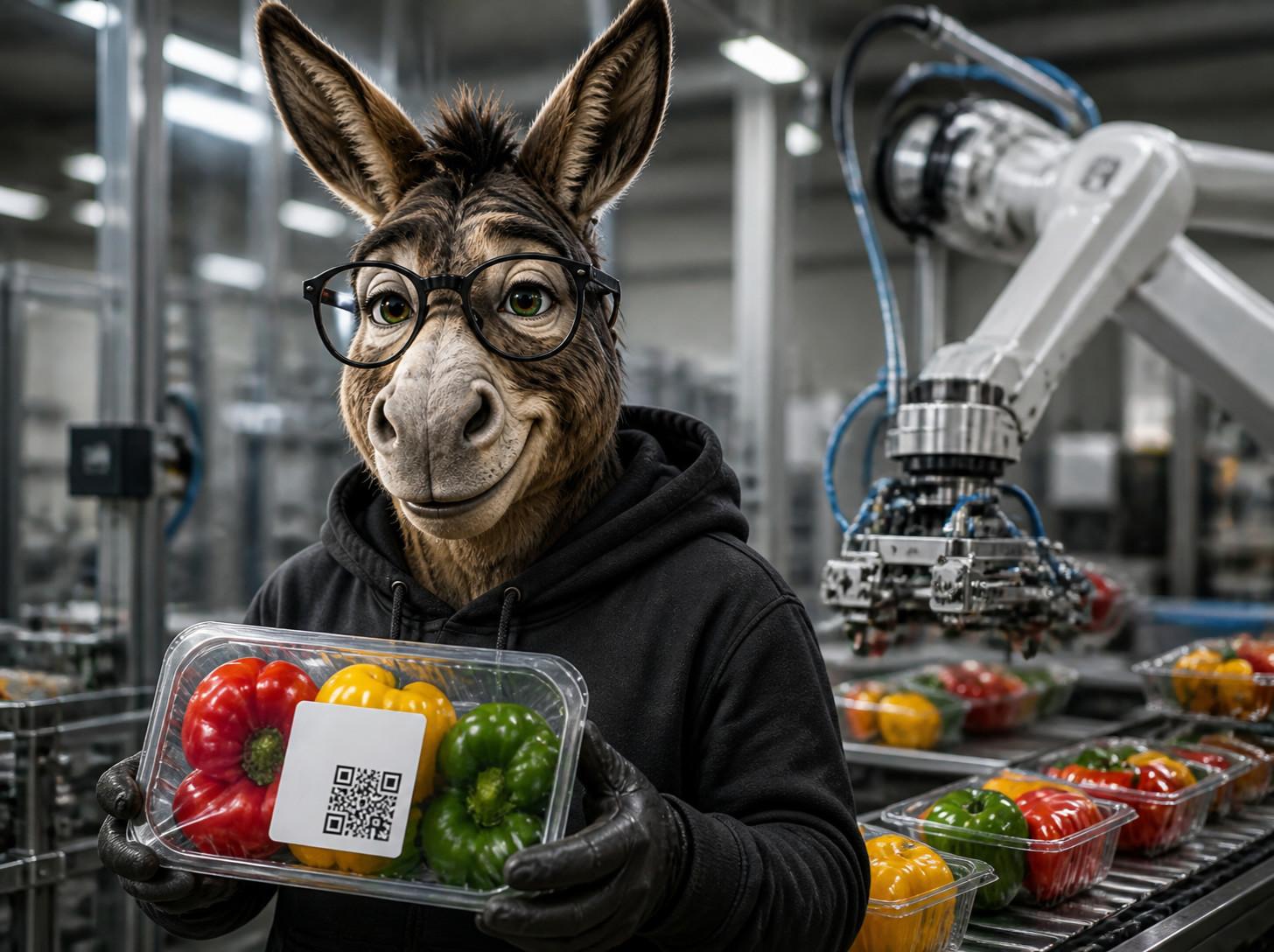 Packing agentCorrect, traceable packs, from greenhouse to shelf.
 Yield forecasting agentKnow how much you'll harvest, when, and at what cost.
Become a pilot farm
Free digital check-up: we look at systems, consumption and problems and tell you whether and where AgriAI can help.