
Skip to content
PenzaıHUMAN TECH
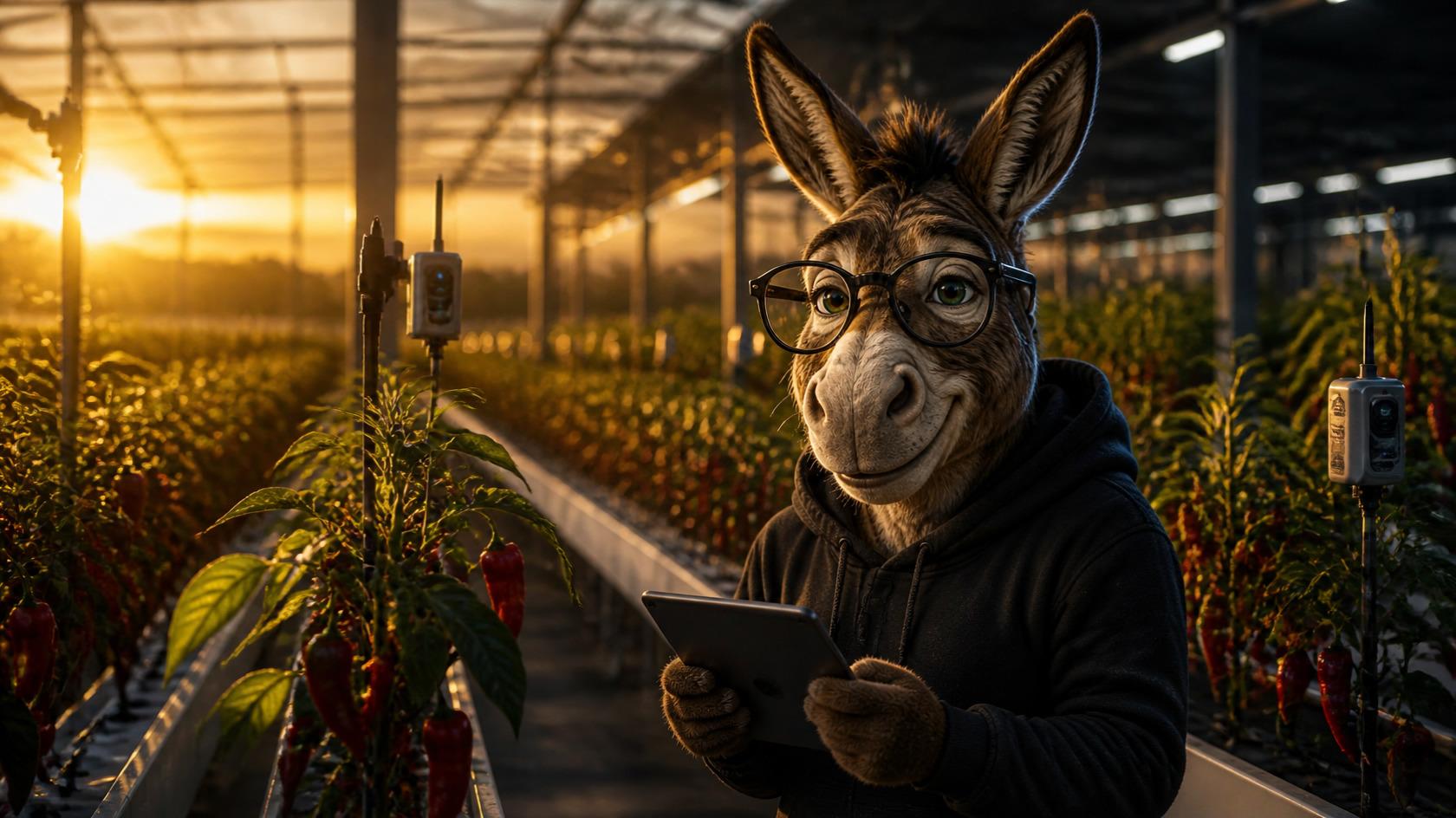
The Penzai mascot with a tablet in a chili pepper greenhouse at sunset
AgrıAIHUMAN TECH
In development · Farm Tech, Rivolta d'Adda (Italy)

From seed to pack: eight AI agents for a complete farm supply chain.

Nursery, transplanting, nutrition, climate, crop protection, harvesting, quality and packing, coordinated by AgriAI OS. People supervise, the scientific team sets protocols and limits.

AgriAI is Penzai's agritech project: a complete supply chain in which eight AI agents follow the crop from seed to pack, coordinated by AgriAI OS, to cut energy and water use, crop losses and repetitive work, always with a person supervising.

It is in development today. We test it first at our Farm Tech, the trial field in Rivolta d'Adda (Cremona, Italy), with soilless growing and a container lab: every feature reaches a farm only after it has been tried there.

The goals

  • Lower farm costs: less repetitive work and fewer wasted inputs
  • Less energy: climate, light and irrigation only when needed, from renewables
  • Fewer crops lost: disease and stress spotted early
  • Zero waste: production matched to demand and every batch traced
  • Less abandoned land: where people no longer go, technology can produce
  • More skilled jobs: monitoring, data, robotics, digital agronomy

We will measure them at the Farm Tech and with pilot farms, and publish results only once they are verified.

The supply chain

A complete supply chain, from seed to pack

Eight agents in phase order. Each hands its data to the next, so every pack knows its history back to the seed batch. Above sits AgriAI OS, which coordinates; below are the people, who decide.

AgriAI OS

Coordinates every agent: one data record, priorities between requests, safety and permissions, and yield forecasting across the whole chain.

People monitorEach phase has an owner who sees what the agents do, approves anything beyond the limits and can always step in.

The scientific team sets protocols and limitsAgronomists and technologists write each phase's protocols and the limits within which agents may decide alone, starting from the literature cited on every page.

The platform

AgriAI OS: the whole chain in one app

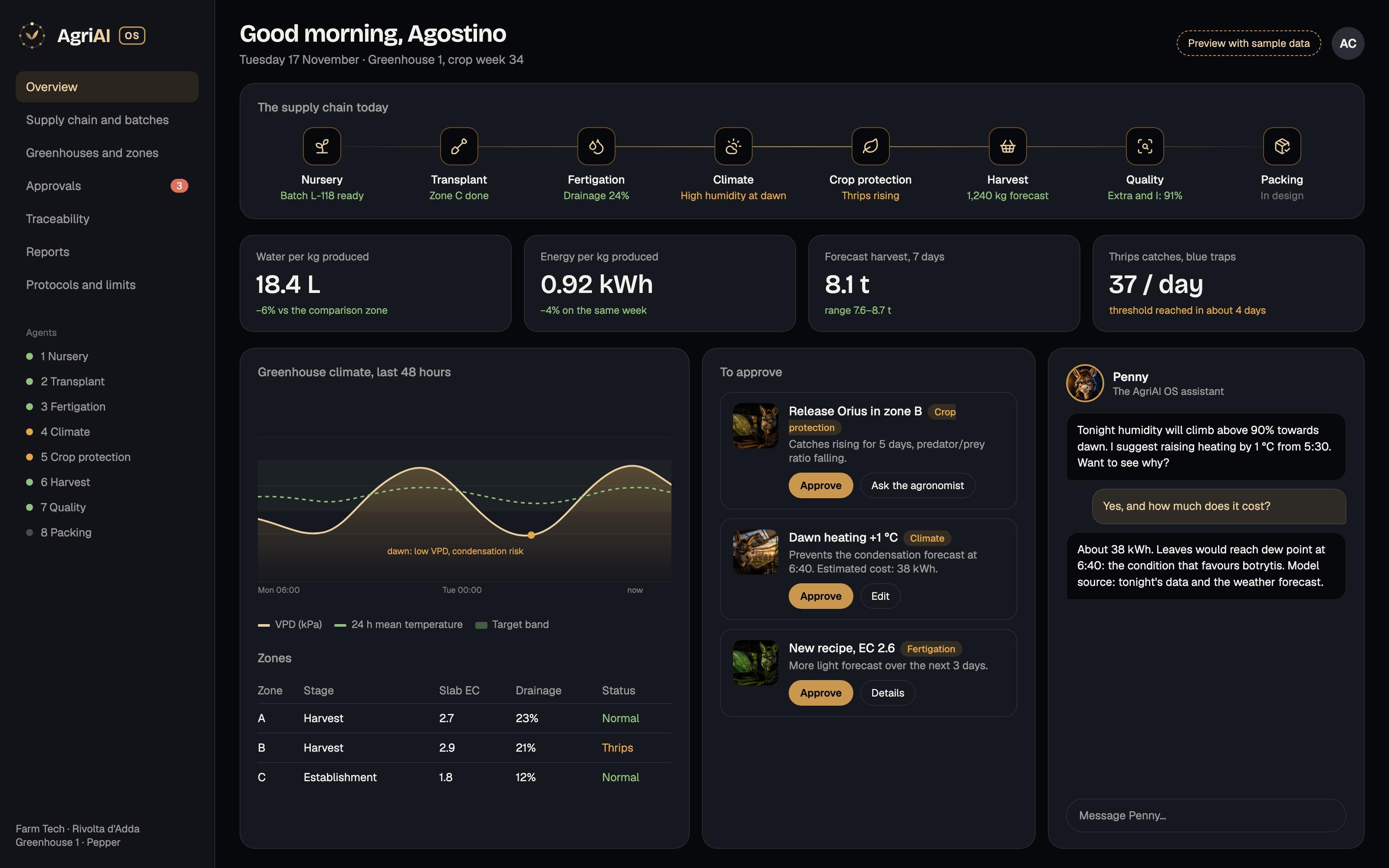
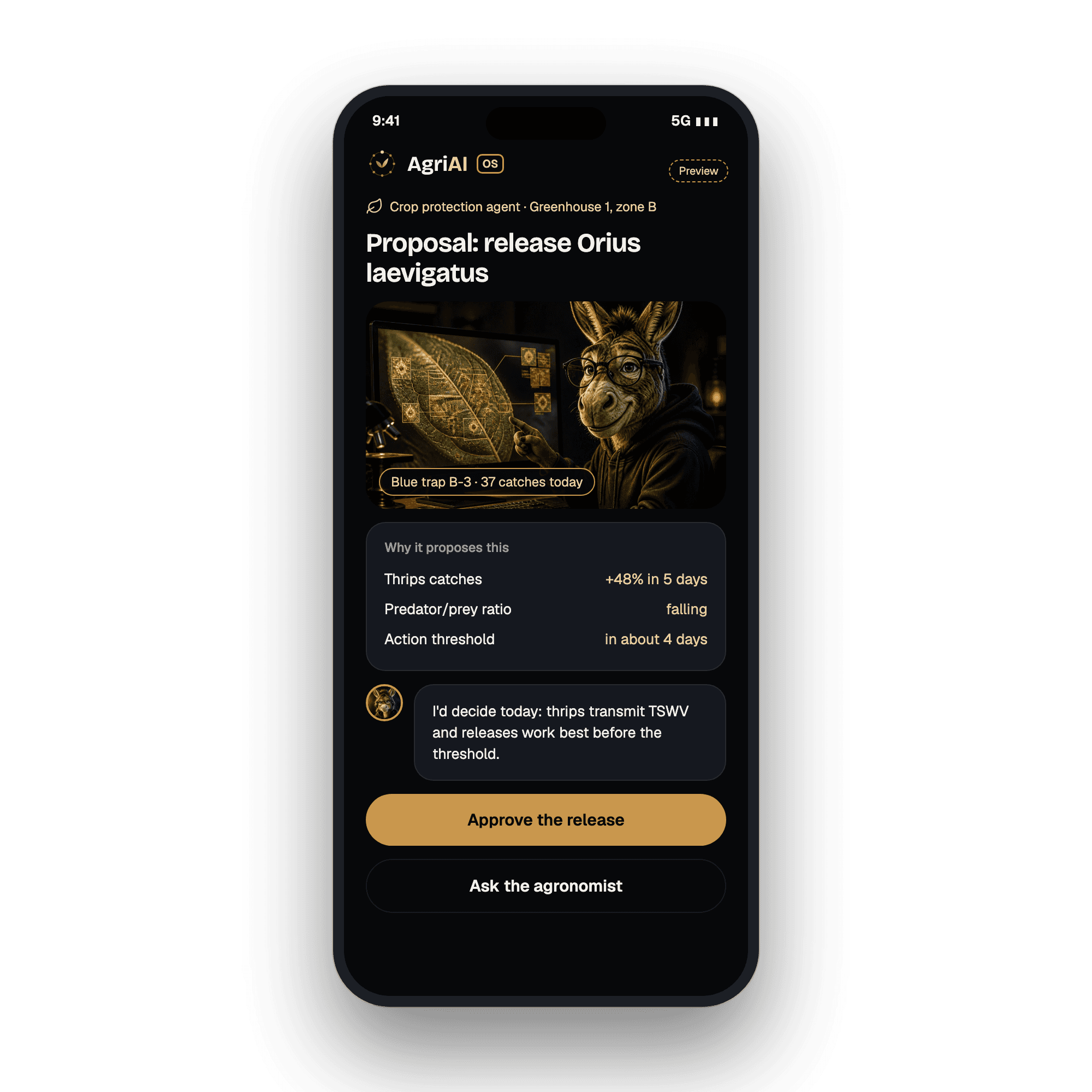
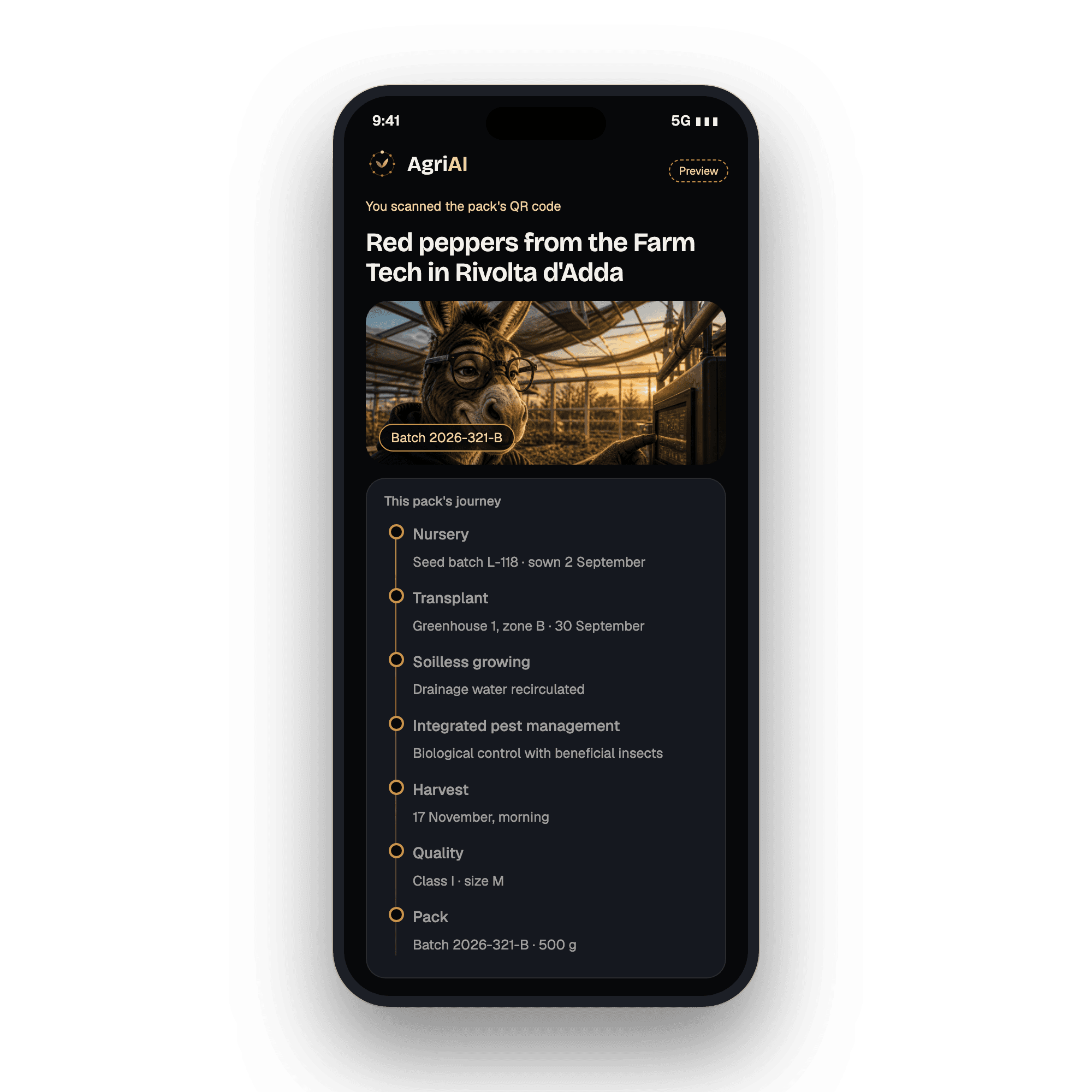
On the computer you see the chain and the zones; on the phone you approve agent proposals with the data behind them. Penny, our mascot, is the assistant who explains every decision. The QR on the label tells the customer the pack's journey.

AgriAI OS Human Tech
AgriAI OS dashboard preview: the eight supply-chain phases, water and energy per kilo, climate chart, proposals to approve and the Penny assistant
App preview: the Crop protection agent proposes a release of beneficial insects, with the data and an approve button
Every proposal comes with the why, and you decide
Preview of the traceability page opened from the QR: the pack's journey from nursery to pack
The label QR tells the whole chain

Illustrative images with sample data: AgriAI OS is in development and the screens show how we are designing it.

The AI agents

Eight specialists, one for each phase

Each agent does a few things, but does them well and all the time. Here is what it does, which data it uses, what it decides alone and what it asks you.

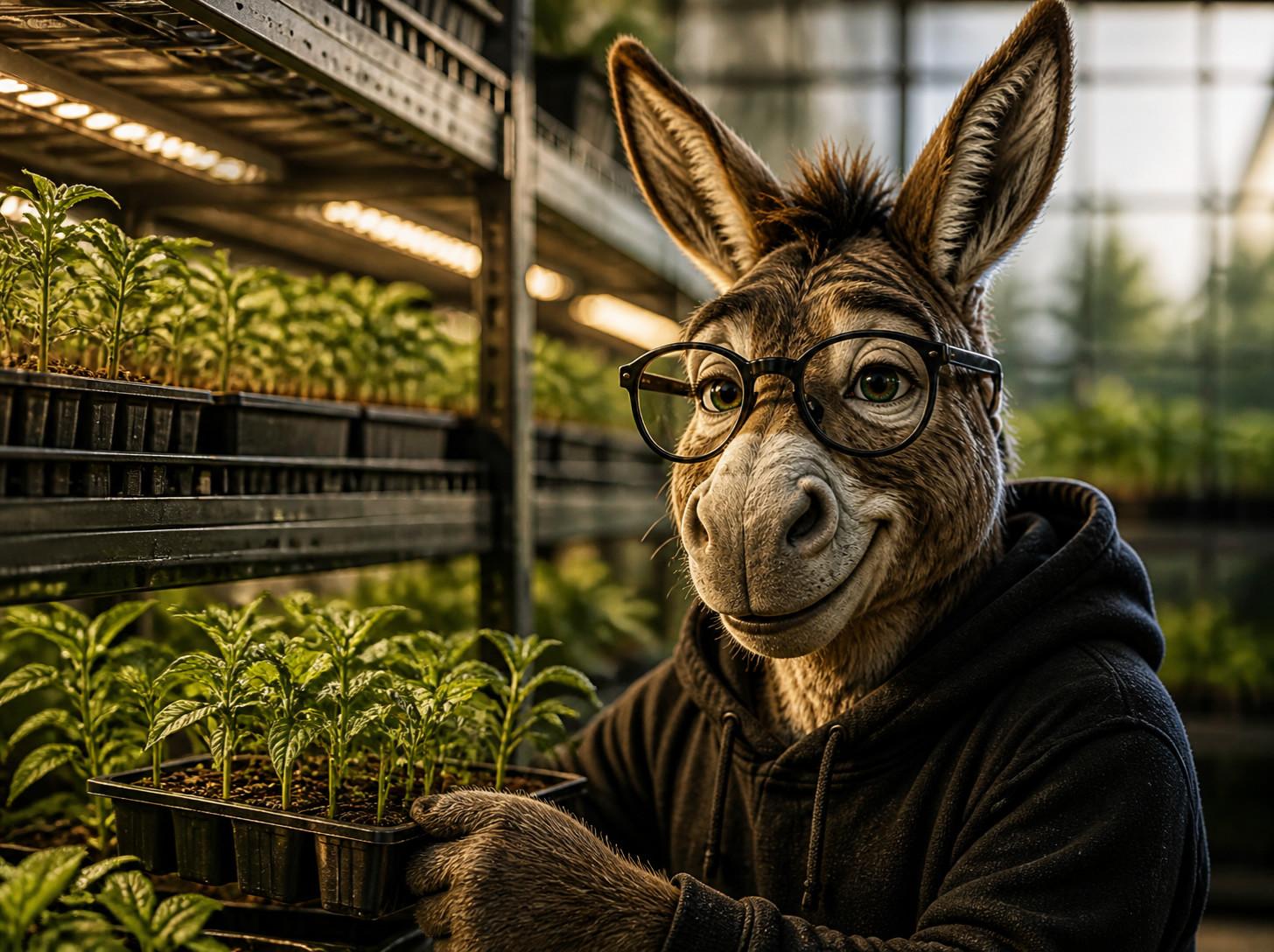
  • The Penzai mascot checks seedling trays in a nursery under LED lightsPhase 1 · In design

    Nursery agent

    Healthy, even seedlings, from seed to transplant.

    What it does

    • Keeps light, temperature and humidity of germination and nursery under control
    • Adjusts LED photoperiod and intensity for compact seedlings
    • Counts germinated seeds and measures uniformity from images
    • Runs ebb-and-flow irrigation of the plug trays
    • Flags leggy seedlings, collar rot and poor germination
    • Says when each batch is ready for transplanting
    Data it uses
    Nursery climate and light, bench cameras, seed batches
    Decides alone
    Climate, lights and irrigation within the nursery protocol
    Asks you
    Discarding a batch or moving the transplant date
    Learn more about this agent
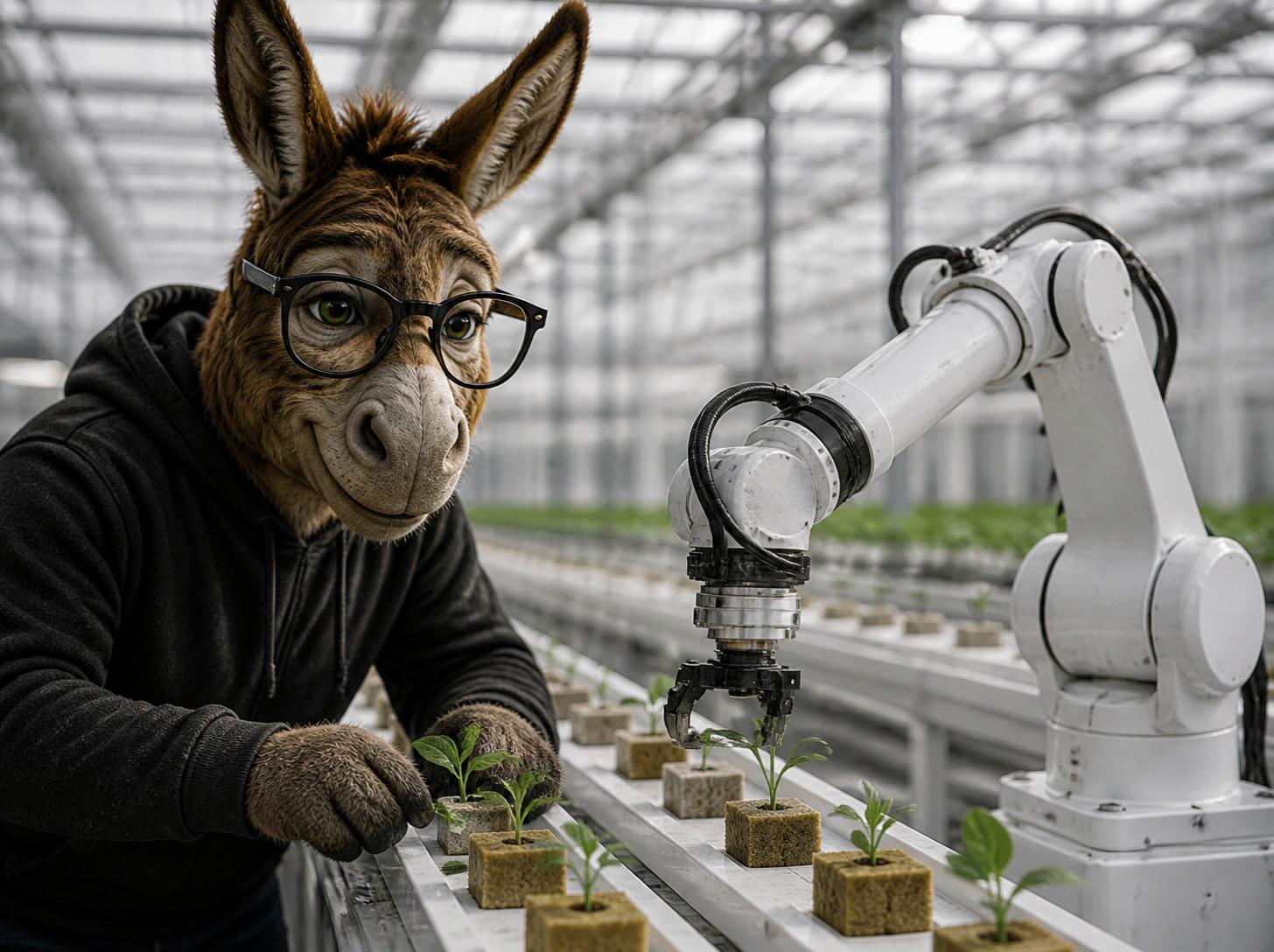
  • The Penzai mascot next to a robotic arm transplanting seedlings into blocksPhase 2 · In design

    Transplant agent

    Every seedling in the right place, at the right time.

    What it does

    • Picks the transplant day from seedling development and weather
    • Selects the best seedlings from images and discards weak ones
    • Guides the robot or transplanter placing them into blocks and slabs
    • Checks the position and depth of every seedling after planting
    • Sets up establishment irrigation with the Fertigation agent
    • Logs seed batch and position of every plant for traceability
    Data it uses
    Nursery data, cameras, zone map, robot or transplanter
    Decides alone
    Seedling selection and zone order
    Asks you
    The transplant date and discards above the threshold
    Learn more about this agent
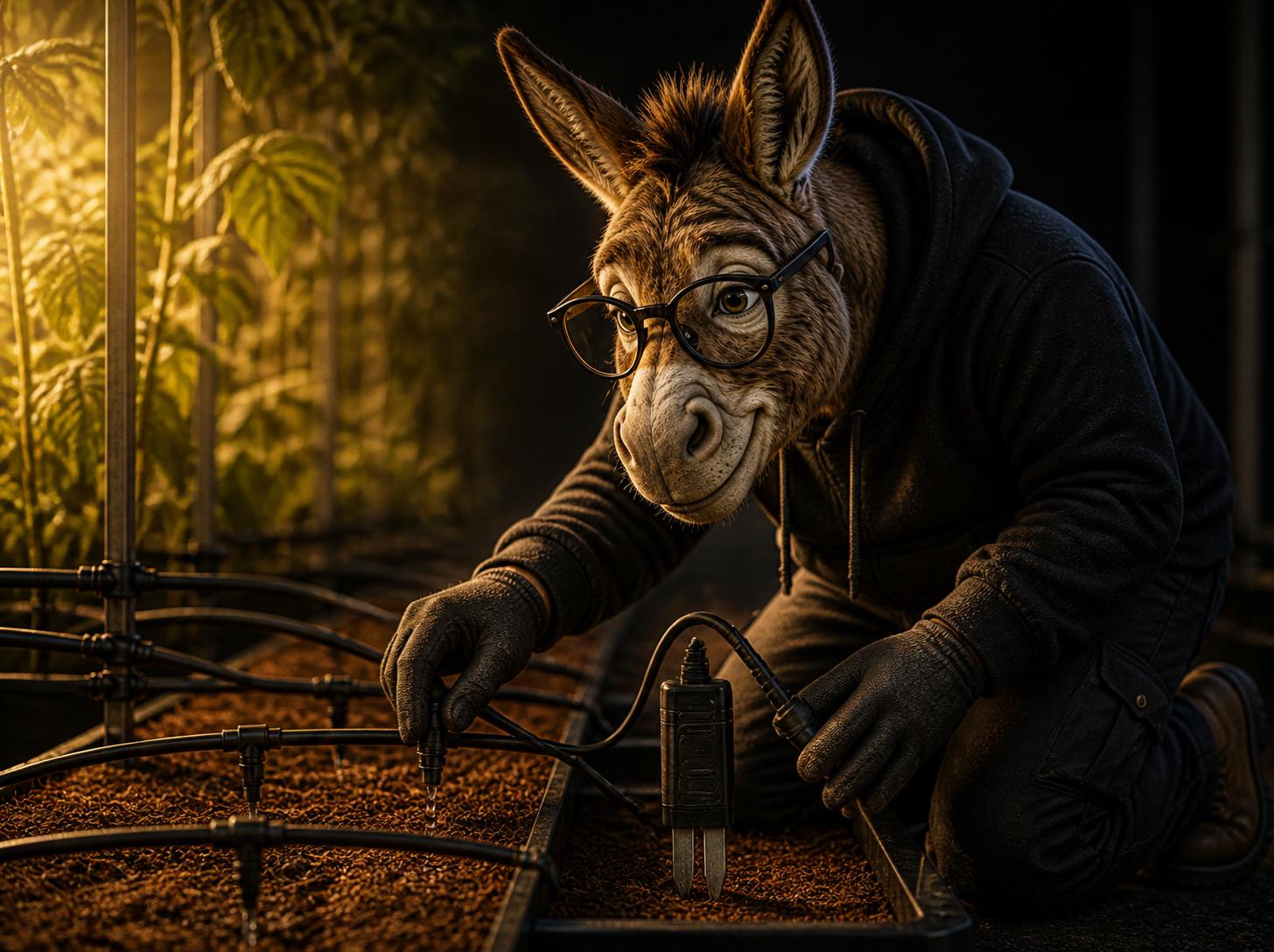
  • The Penzai mascot checks drip irrigation and a moisture sensorPhase 3 · In development

    Fertigation agent

    The right water and nutrients, at the right time.

    What it does

    • Reads moisture, conductivity (EC) and pH of the substrate or soil
    • Decides when and how much to irrigate, zone by zone
    • Doses nutrients for the crop's growth stage
    • Takes the day's weather and evaporation into account
    • Flags leaks, clogged drippers and unusual consumption
    • Logs the water and fertilizer used, ready for inspections
    Data it uses
    Substrate sensors, water meters, weather
    Decides alone
    Irrigation within the limits you set
    Asks you
    Any change to the nutrient recipe
    Learn more about this agent
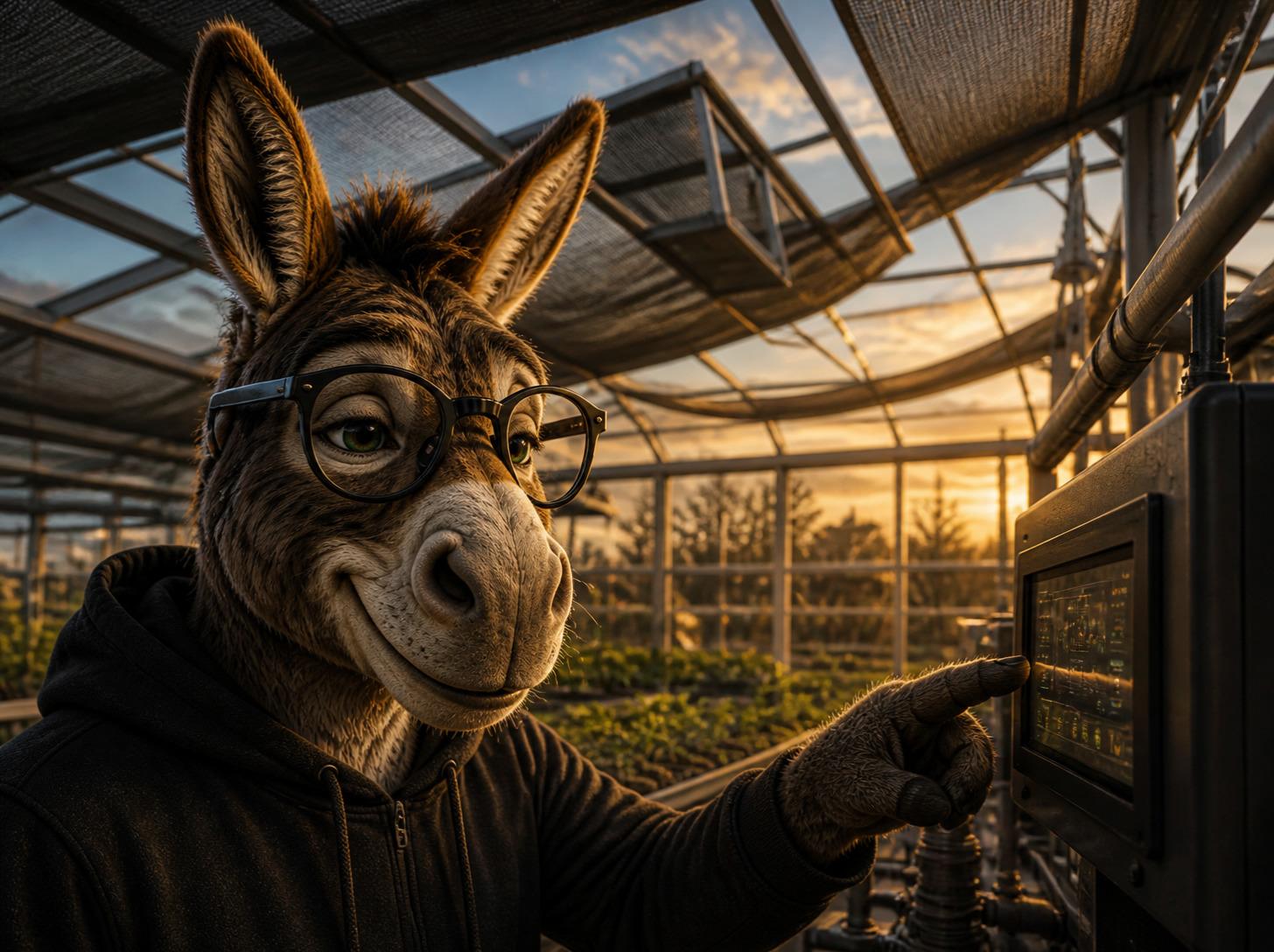
  • The Penzai mascot at a greenhouse climate controllerPhase 4 · In development

    Climate agent

    The greenhouse always in the ideal climate, with less energy.

    What it does

    • Monitors temperature, humidity, CO₂ and light
    • Opens and closes vents, shade screens and fans
    • Anticipates heat and cold using the forecast
    • Prevents condensation and humidity that favor disease
    • Shifts consumption to the hours when solar is producing
    • Instant alarm for frost, extreme heat or faults
    Data it uses
    Climate controller, indoor sensors, weather station, solar
    Decides alone
    Adjusting vents, screens and ventilation
    Asks you
    Heating beyond the energy budget
    Learn more about this agent
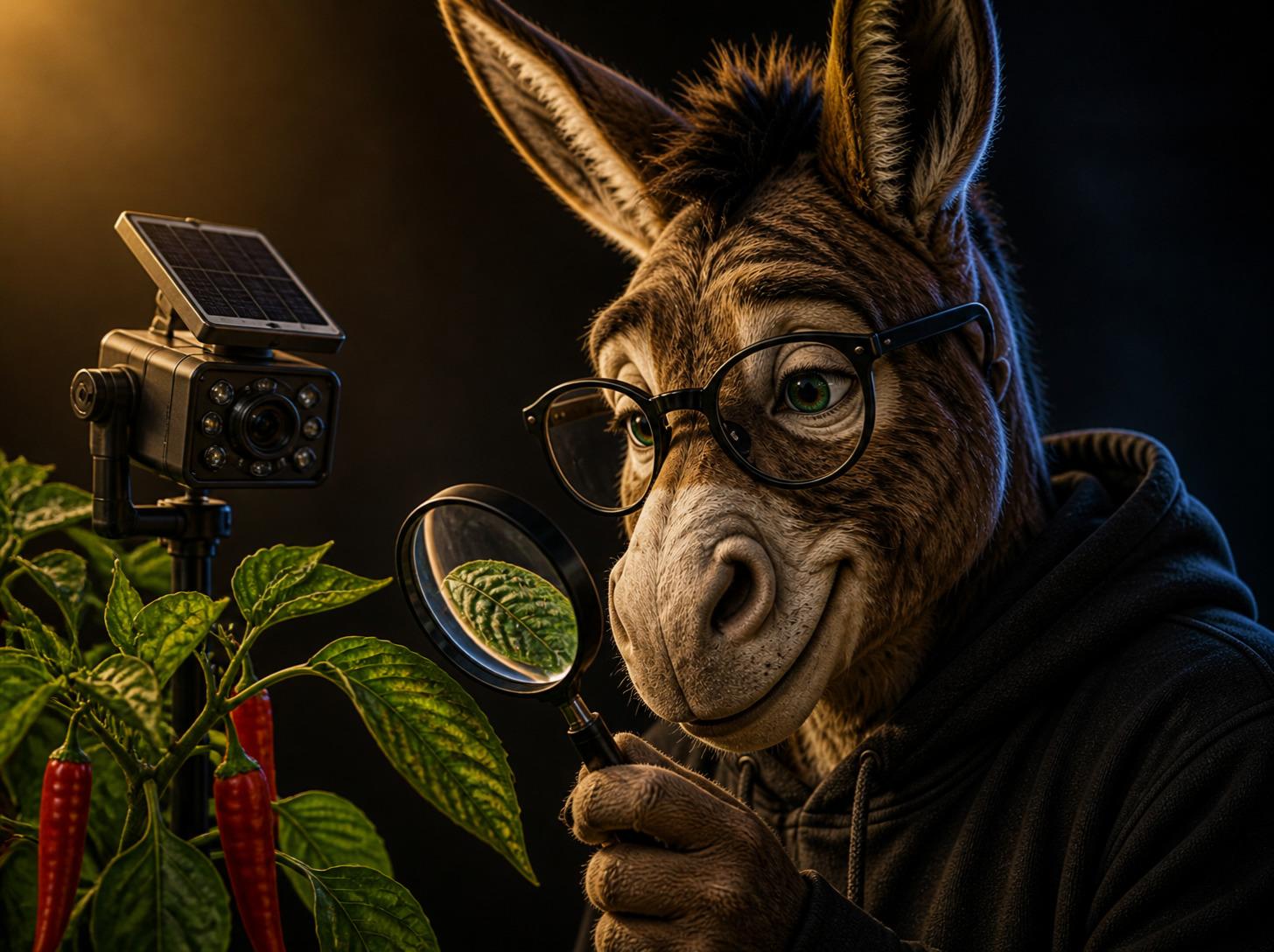
  • The Penzai mascot inspects a chili pepper leaf with a magnifierPhase 5 · In development

    Crop protection agent

    Spots problems before they become damage.

    What it does

    • Analyzes photos from fixed cameras or your phone
    • Recognizes early signs of stress, deficiencies and disease
    • Counts insects on photographed traps
    • Estimates disease risk from climate conditions
    • Proposes the treatment and logs it after your go-ahead
    • Alerts you or your agronomist with photos and data
    Data it uses
    Cameras, field photos, traps, climate
    Decides alone
    Continuous monitoring and alerts
    Asks you
    Always, for any treatment
    Learn more about this agent
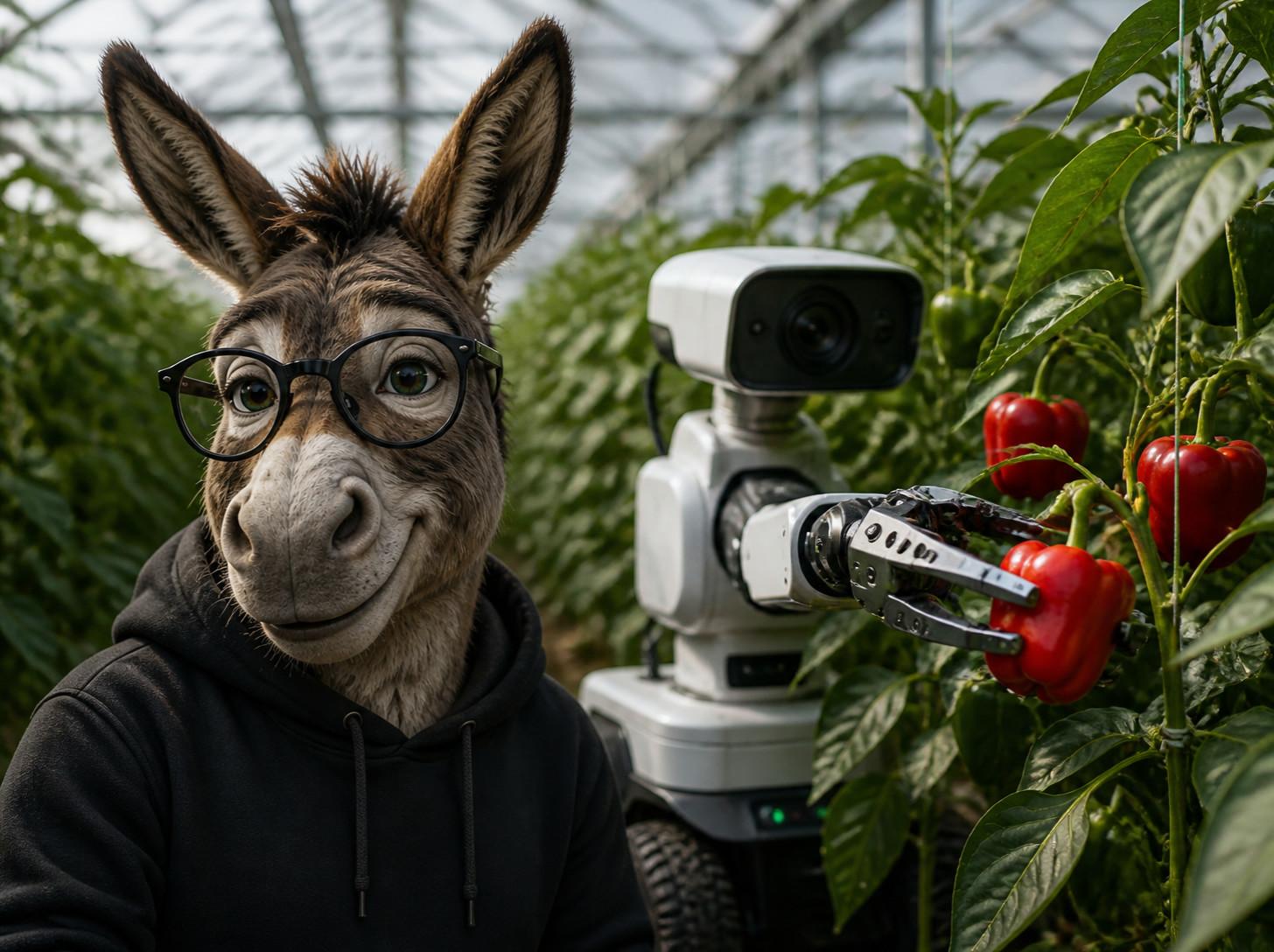
  • The Penzai mascot next to a robot picking ripe peppers in a greenhousePhase 6 · In design

    Harvest agent

    Only ripe fruit, picked without damage.

    What it does

    • Recognises ripe fruit from images by colour and size
    • Plans picking rounds by zone and day
    • Guides robots that detach the fruit without bruising it
    • Supports crews by pointing out ready rows and plants
    • Weighs and logs the harvest by zone, in real time
    • Passes data to Quality and to yield forecasting
    Data it uses
    Colour and depth cameras, scales, yield forecast
    Decides alone
    Picking plan and ripe-fruit count
    Asks you
    Picking earlier or later than planned
    Learn more about this agent
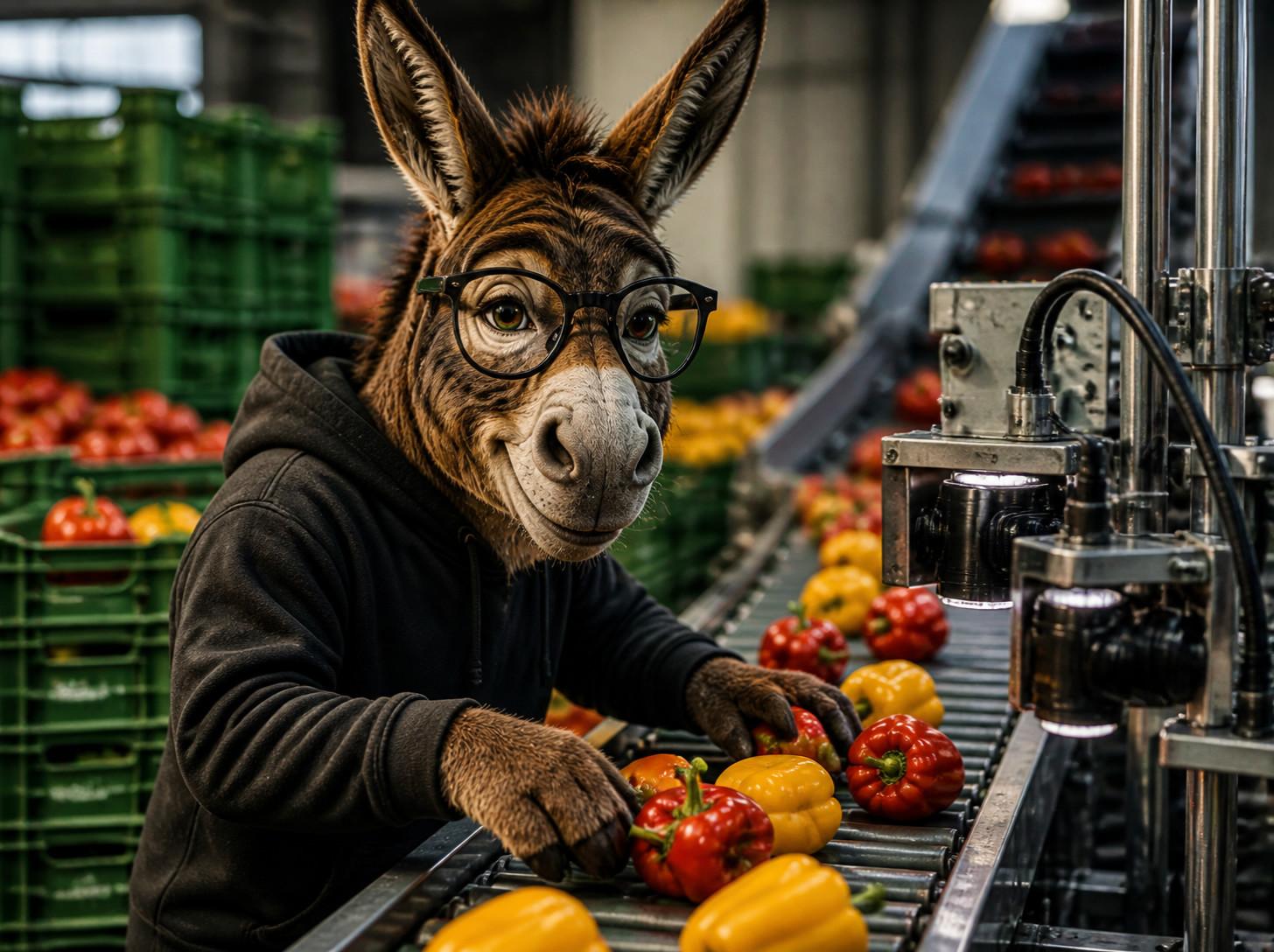
  • The Penzai mascot watches peppers on a camera grading linePhase 7 · In design

    Quality agent

    Every fruit in the right grade.

    What it does

    • Measures size, colour and shape of every fruit with computer vision
    • Spots defects: bruises, sunscald, rot, deformities
    • Assigns grade and size class under marketing standards
    • Sorts fruit automatically on the grading line
    • Links defects to causes in the greenhouse and alerts the other agents
    • Logs quality statistics by batch and customer
    Data it uses
    Line cameras, scales, marketing standards, harvest data
    Decides alone
    Sorting within agreed specifications
    Asks you
    Downgrading a batch or a new customer specification
    Learn more about this agent
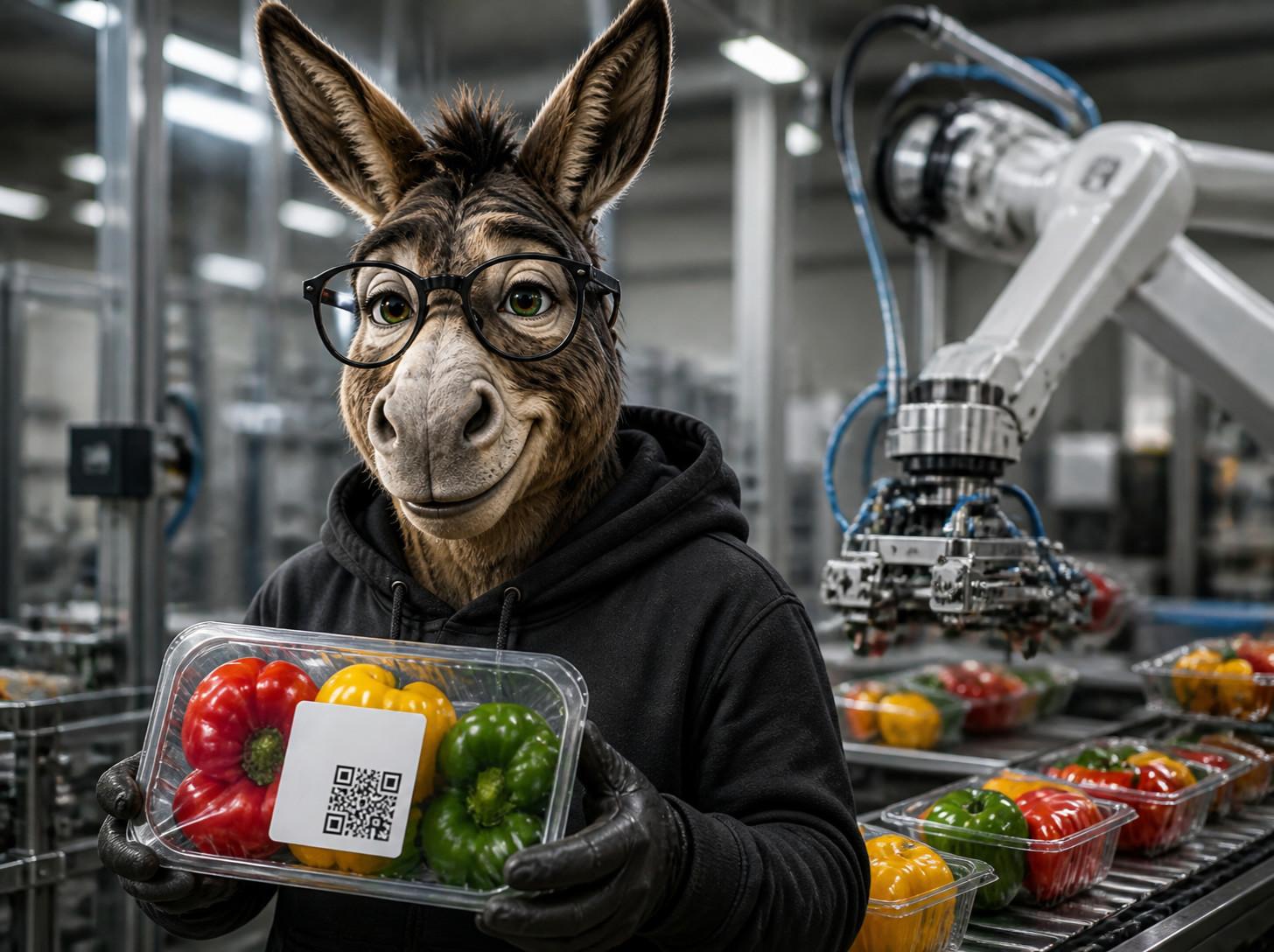
  • The Penzai mascot checks a pack of peppers with a label and QR codePhase 8 · In design

    Packing agent

    Correct, traceable packs, from greenhouse to shelf.

    What it does

    • Prepares the day's orders from available harvest and quality
    • Guides robotic packing: weights, counts and formats per customer
    • Prints the batch and a traceability QR code on the label
    • Links every pack to zone, harvest date and treatments
    • Checks weight and label before shipping
    • Prepares shipping documents and customer data
    Data it uses
    Orders, harvest and quality, scales, label printers
    Decides alone
    Pack composition and label printing
    Asks you
    Product substitutions or out-of-spec orders
    Learn more about this agent

Gradual adoption

Agents that pay off now first, robots later

A greenhouse without staff is not the starting goal. We begin with proven technology and add innovation only when it is economically sustainable: less upfront investment, less technology risk.

  1. 1IoT and sensorsProven systems
  2. 2Artificial intelligenceAgents that analyse and decide
  3. 3AutomationAutomated processes
  4. 4Proven roboticsField-tested technology
  5. 5Advanced roboticsPilot projects with technology partners

Phase A · now

Four priority agents, no robots

Fertigation, Climate, Crop protection and Yield forecasting: they create value straight away with existing sensors and systems.

Phase B · next

Robotics arrives

Nursery, Transplant, Harvest, Quality and Packing, once the first agents have proved they work and save money.

Phase C · goal

Advanced automation with human supervision

AgriAI OS coordinates agents and systems; people supervise and step in on anomalies. Safety comes from rules independent of the AI.

The AI's levels of autonomy

  1. Level 1AI analyses and suggests
  2. Level 2AI carries out authorised actions
  3. Level 3AI coordinates several systems, supervised
  4. Level 4Advanced automation, with human intervention on anomalies

Safety is independent of the AI model.

The agents' safety rules

  • Operating limitsEach agent acts only within ranges set by agronomists.
  • Safety thresholdsBeyond a threshold the agent stops and raises an alarm.
  • Decision logEvery decision is logged and explained, to check and improve it.
  • Human interventionA person can always stop or correct an agent.

How they work together

Data starts at the systems, agents propose, limits check, and you keep the final say.

  1. Sensors and systemsThe ones you have, plus weather and satellite
  2. AI agents and AgriAI OSRead the data and propose what to do
  3. Safety limitsEvery action is checked and logged
  4. You decideApprove from your phone anything beyond the limits
  5. The cropLess waste, a more predictable harvest
Works with what you have
Connectors to sensors, controllers and systems already installed: no proprietary hardware to buy.
You have the final say
Agents act on their own only within safety thresholds, every decision is logged and you can always step in.
Renewable energy
Designed to run on solar power, and modular: start with one agent and add the others when you need them.
Trained people
We train agritech operators, including people returning to work, together with job centers and training bodies.

Products

Everything you need, one piece at a time

It starts with the portal and the connector; kits are only needed where sensors are missing. No product is on sale yet: we are building and testing them at the Farm Tech.

  • In development

    AgriAI Portale e app

    The heart of the service: AgriAI OS with the supply-chain agents, the farm map, alerts and reports, on the web and your phone. By subscription.

    • 8 AI agents and AgriAI OS
    • Chat alerts
    • Reports and records
  • In development

    AgriAI Connect

    The connector that brings data from your existing controllers, sensors and systems into the portal, and sends back approved commands.

    • Modbus and MQTT
    • Manufacturer APIs
    • Works offline too
  • Testing at the Farm Tech

    AgriAI Kit Serra

    For those starting from scratch: substrate and climate sensors and a low-cost controller, ready to connect to the portal.

    • Moisture, EC and pH
    • Temperature, humidity, CO₂
    • Valve control
  • Phase 2

    AgriAI Kit Campo

    For open fields and recovered land: soil probes, a weather station and a long-range network, solar powered.

    • Soil probes
    • Weather station
    • LoRaWAN network
  • Phase 2

    AgriAI Kit Visione

    Fixed cameras and photo traps that give the Crop protection agent its eyes.

    • Cameras between rows
    • Insect traps
    • Phone photos
  • Phase 2

    Laboratorio mobile

    The Farm Tech on wheels: we bring sensors, agents and demos straight to your farm.

    • On-farm demos
    • Field trials
    • Training

The technology we use

Open, widespread components that are easy to find and replace, without tying you to a single supplier.

  • ESP32 and Arduino boards
  • Capacitive moisture sensors
  • EC and pH probes
  • Weather station
  • LoRaWAN gateway
  • Modbus and MQTT protocols
  • Cameras and photo traps
  • Solar with storage
  • Copernicus satellite imagery
  • Open-source and cloud AI models

Sensors

Every sensor, and which agent uses it

The full list: 33 sensors and data sources. You don't need them all: we start from what the farm already has, linked through the existing controller or a radio gateway, and add only what is missing.

Coreneeded to startExtraadds precision where it pays

Sensors used by the AgriAI agents
Sensor and what it measuresWhere it goesNurseryTransplantFertigationClimateCrop protectionHarvestQualityPacking
Water, nutrients and substrate
Substrate moisture probeCoreWater available in the substrate or soil (volumetric water content); many probes also read EC and temperatureIn the slab or soil, at root depth, on representative plants in every zone
Conductivity (EC) sensorCoreHow much salt is dissolved in the nutrient solution, in mS/cmIn line on the supply and in the collected drainage
pH sensorCoreAcidity of the solution, which decides how available the nutrients stayIn line on the supply and, by sampling, in the drainage
Drainage meterCoreThe water leaving the slabs, to work out the drainage percentageDownstream of a reference gutter (tipping bucket or tank with a level sensor)
Water meter (flow meter)CoreLitres delivered per zone and per cycleOn every line or zone valve
Lab analysis of water and drainageCoreIndividual elements (nitrate, potassium, calcium, magnesium, sodium, chloride…) that EC cannot tell apartSamples sent to a lab every few weeks
Gutter scale (load cell)ExtraWeight of substrate and plants: water used and transpiration minute by minuteUnder a gutter with representative plants
Root-zone temperatureExtraTemperature of the solution and the substrateIn the slab and in the solution tank
Line pressure sensorExtraSystem pressure during irrigationAfter the pump and filters, and at the end of the line
Tank level sensorExtraHow much stock solution, acid and water is left in the tanksIn every stock, acid and water tank
Climate inside the greenhouse
Air temperature and humidity (aspirated box)CoreTemperature and relative humidity; VPD and dew point are worked out from themAt canopy height, in a shielded, aspirated box, at least one per compartment
CO₂ sensor (NDIR infrared)CoreCarbon dioxide concentration in ppmIn the middle of the crop, away from doors and burners
PAR light sensorCoreLight useful for photosynthesis in µmol/m²/s and the daily totalAbove the crop, level and unshaded
Vent, screen and heating statusCoreVent opening, screen position, valves and boiler on or offRead from the climate controller you already have
Infrared leaf thermometerExtraLeaf temperature, without contactAimed at the canopy, from above or the side
Leaf wetness sensorExtraWhether leaves are wet, and for how many hoursIn the canopy, where condensation forms first
Energy and gas metersExtraHeating and pump use, solar productionOn the switchboard, the boiler and the inverter
Outside the greenhouse
Weather stationCoreTemperature, humidity, solar radiation, wind and rain outside the greenhouseOn top of or next to the greenhouse, clear of obstacles
Weather forecastCoreExpected temperature, radiation and rain over the coming daysAn online data service: nothing to install
Satellite imagery (Sentinel-2)ExtraVegetation indices such as NDVI, mostly useful in open fieldsFree data from the EU Copernicus programme, updated every few days when skies are clear
Plants, images and harvest
Fixed or trolley-mounted camerasCoreImages of the plants to spot symptoms and count flowers and fruitsOn a trolley running on the heating pipes, or at fixed points
Sticky traps with a cameraCoreInsects caught each day: thrips, whiteflies, winged aphids and othersBetween rows, at the height of the plant tops
Field photos and notes (smartphone)CoreObservations by the people working in the greenhouse: symptoms, fruit counts, crop stagesFrom the AgriAI app, during the greenhouse walk
Harvest weighingCoreKilos picked per zone and per dayA scale in the greenhouse or warehouse, linked to the platform
Multispectral or thermal cameraExtraLight reflected beyond the visible range and canopy heat, to see stress before symptomsOn a trolley, at a fixed point or, in open fields, on a drone
Dendrometer (stem sensor)ExtraChanges in stem diameter over the dayOn the stem of a few reference plants
Nursery, robots, line and warehouse
Germination chamber sensorsCoreSubstrate temperature in the trays, air temperature and humidityInside sample trays and at bench height
Depth camera (RGB-D)CoreColour image plus the distance of every point: 3D position of seedlings, fruit and stemsOn the robot arm or the trolley
Gripper force sensorExtraHow much force the gripper applies to seedling or fruitIn the robot gripper's fingers
Grading line camerasCoreSize, colour, shape and defects of every fruit, from several sidesIn a booth with controlled lighting over the belt
Line scales and checkweighersCoreWeight of every fruit and every packOn the grading belt and at the packing exit
Barcode and QR readersCoreThe code of crates, batches and packs at every stepAt line entry, packing and dispatch
Cold-store temperature and humidityCoreStorage conditions of harvested and packed produceIn the cold store and, with loggers, in transport vehicles

Generic categories, no brands: the agents work with sensors from any maker, as long as the data can be read. Installation and calibration details are on each agent page.

Use cases

How it works in practice

Typical scenarios, not real customers: they show how AgriAI is meant to work. Real case studies will come with the pilot farms, with measured numbers.

  • Typical scenario

    A soilless chili pepper greenhouse

    Today
    Irrigation runs on a fixed timer and vents are opened by eye: water is wasted in summer, heating overshoots in winter.
    With AgriAI
    The Fertigation and Climate agents irrigate from substrate readings and tune the greenhouse to the forecast, within limits set by the agronomist.
    What we measure
    Water and energy per kilo, before and after
  • Typical scenario

    A vegetable farm with controllers already in place

    Today
    The data exists but stays locked in each controller: you have to walk into the greenhouse to see what is happening.
    With AgriAI
    AgriAI Connect brings everything into one portal without changing hardware, and alerts arrive on the phone.
    What we measure
    Time spent on checks, useful alerts
  • Typical scenario

    An abandoned municipal plot

    Today
    A plot left idle for years, costing upkeep and earning nothing for anyone.
    With AgriAI
    A multi-year agreement with the municipality: Penzai brings it back into production, run remotely, with operators trained locally.
    What we measure
    Hectares recovered, people trained
  • Typical scenario

    A cooperative with many members

    Today
    Each member uses their own tools: data can't be compared and the agronomist's advice arrives late.
    With AgriAI
    One portal for all members, with the agronomist seeing every farm and agents applying their advice.
    What we measure
    Crop losses, response times

Who it is for and what they get

  • Farms and greenhouses

    Agents working on the systems you already have, a free check-up to start and reports on consumption and yields.

  • Cooperatives and consortia

    One platform for several member farms, with comparable data and shared support.

  • Agronomists and advisors

    Your clients' field and greenhouse data in one place, and agents that apply your advice within limits you set.

  • Solar and greenhouse installers

    One more service for your customers: connect AgriAI to the systems you install and become a partner.

  • Landowners and public bodies

    Idle land produces again under multi-year agreements, without you having to run it.

  • Job centers and training bodies

    Courses that train agritech operators, designed also for people changing jobs after 35.

Around the agents, a platform

The features we are designing for the AgriAI portal, on the web and on your phone.

  • Map of fields and greenhouses

    Every plot and greenhouse zone with its sensors, crops and history of operations.

  • Weather and satellite

    Local forecasts and satellite vegetation images next to your sensor data.

  • Digital record of operations

    Irrigation, fertilizing and treatments recorded automatically, ready for inspections and certifications.

  • The agent in chat

    Ask from your phone how a greenhouse is doing or what the agent decided, and approve actions with a message.

  • Costs and margins per crop

    Water, energy, fertilizer and labor hours assigned to each crop, so you know where you really make money.

  • Sustainability report

    Water, energy and emissions per kilo produced, useful for supply chains, buyers and grants.

Architecture

How AgriAI OS is built, from sensor to decision

One central platform with six intelligence modules, a single data platform and connectors to any system. Underneath sits a deterministic rules engine: AI proposes, rules check.

  1. AgriAI Web and MobileDashboard, smartphone, multi-farm management
  2. API and Core PlatformAuthentication, multi-tenant, permissions, audit of every access
  3. AgriAI OS

    • Crop IntelligenceCrops, growth, yields and production cycles
    • Irrigation AIIrrigation, pH, EC and fertigation
    • Climate AITemperature, humidity and ventilation
    • Vision AIDisease, stress and ripeness
    • Predictive AIYield and cost forecasts
    • RoboticsRobot control and coordination
    • Agent OrchestratorCoordinates the AI agents
    • Event EngineEvents and automations
    • Data PlatformHistory, telemetry and batches
    • Rules EngineLimits and safety
  4. IoT and Hardware GatewayMQTT · Modbus · OPC UA · sensors · PLC
  5. IrrigationClimateRobotics

An AI agent cannot freely change an industrial controller: every action goes through deterministic checks and authorisations.

The three non-negotiables

  • Reliable telemetry
  • Rules engine with safety limits
  • Data history and traceability of every AI decision

The technology stack

Technologies used by AgriAI OS
BackendNode.js / NestJS
FrontendNext.js / React
DatabasePostgreSQL + TimescaleDB
EventsMQTT + BullMQ, Redis
IoTESP32, industrial gateways, Modbus, OPC UA
Computer visionPython + OpenCV
Machine learningPyTorch
AI agentsLLMs + specialised models
InfrastructureDocker + Kubernetes, S3 storage
MonitoringPrometheus + Grafana

Compatible with the systems you already have

Farmers throw nothing away: they keep their systems and make them smart. Whatever the brand or age, everything flows into one portal.

  1. Case 1The maker already has a connectorWe link it to AgriAI OS straight away.
  2. Case 2No connector existsWe write it and link it to AgriAI OS.
  3. Case 3Analogue system or no dataWe fit an Arduino-type board costing a few euros, build the connector and link it.

What the farmer pays for

  • Hardware, only if neededLow-cost sensors or modules for systems without data.
  • The connectorLinking or building the connector for your system.
  • The subscriptionAccess to AgriAI OS, the agents, the data and updates.

Low upfront investment, clear costs and gradual growth. Prices will be set after the pilot phase.

Four levels, from smartphone to robot

  1. AgriAI FieldWith a smartphone, minimum costPhotos, notes and agent advice in the field, no systems needed
  2. Greenhouse StartSmall greenhousesThe first agents on the systems you already have
  3. AgriAI OS ProEstablished farmsAll agents, several greenhouses and users
  4. AgriAI 100% roboticoThe end goalAI agents and robots across the whole chain

The roadmap in five phases

We move to the next phase only with verified results: no large investment before concrete proof of feasibility.

  1. Phase 0 · Foundations

    Nov 2026 – Jan 2027

    • Planning and permit checks
    • Soil and water analysis, agronomic and energy design
    • Choice of soilless system, scientific team, AgriAI OS architecture
  2. Phase 1 · MVP and pilot

    2027

    • A 300–500 m² pilot with sensors and dashboard
    • Fertigation and Climate agents, computer vision
    • Plot comparison and real data collection
  3. Phase 2 · Validation

    After the first production cycle

    • Independent review of results and algorithms
    • Cost per kg produced
    • First commercial version and first external customer
  4. Phase 3 · Industrialisation

    After validation

    • More growing area and robot integration
    • Hardware partnerships and Start and Pro packages
  5. Phase 4 · Going international

    Final phase

    • Distribution through partners and an installer network
    • Adapting to other languages, crops and climates, APIs and integrations

Installers and agronomists: become partners

We are looking for solar, farm-system and greenhouse installers and agronomists who want to bring AgriAI to their clients.

Write to us

Grants and funding

Digitalization, farming 4.0 and renewable energy often have dedicated grants. In the free check-up we check which ones may apply to your farm.

We discuss it openly in the Community: sensors, fertigation, energy, agronomic data and the progress of the Farm Tech.

Farming 4.0 and precision farming, in plain words

The words you hear at trade fairs and in grant calls, explained for growers. AgriAI brings all of them together in one service.

Farming 4.0
Farms where sensors, machines and software are connected and share data, so decisions rest on measurements and not only on experience.
Precision farming
Giving each zone of a field or greenhouse only the water, nutrients and treatments it needs, instead of treating everything the same.
Smart greenhouse
A greenhouse where climate, irrigation and light are adjusted automatically from sensors and the weather forecast.
Soilless growing
Plants grow on substrates such as coir or rock wool, or in water, with measured nutrients: less water is used and the crop is easier to control.
AI agent
Software that does more than show data or give advice: it observes, decides and acts on a system, within rules and limits set by a person.
Agricultural IoT
The network of connected sensors and devices (moisture, climate, valves, cameras) that carries data from the field to software and commands back to the field.

Scientific method

How we test every feature at the Farm Tech

Before reaching a farm, every agent goes through a five-step test protocol.

  1. 1

    Side-by-side zones

    At the Farm Tech the same crop grows in zones run by the agents and zones run the traditional way, under the same conditions.

  2. 2

    Measurements, not impressions

    Water and energy meters, harvest weights, counts of affected plants: every goal has a number measured the same way.

  3. 3

    Whole seasons

    A result only counts if it holds for a full season: trials of a few weeks are not enough.

  4. 4

    External review

    An agricultural and technology scientific committee and our network of agronomists review protocols and results before we publish them.

  5. 5

    Public results

    We publish method, data and results, even when an idea does not work: that is how trust is built.

The scientific committee: a verifiable project

The pilot follows a real trial protocol, and the scientific committee is its guarantor.

  1. DesignsThe trial protocol and growing rules
  2. MeasuresChooses indicators and measurement methods
  3. ChecksChecks the data and the AI agents' decisions
  4. ValidatesAnalyses and certifies the results
APlot under traditional management
vs
BPlot assisted by AgriAI

Same variety, comparable conditions, documented protocols

Indicators measured in the pilot
IndicatorUnit
Yieldkg/m²
Waterlitres per kg produced
EnergykWh per kg produced
Fertilisergrams per kg produced
Labourhours per kg produced
Quality% marketable produce
Losses% waste
Costs€ per kg produced
Artificial intelligenceforecast accuracy
Automationhuman interventions needed

That is how we show with data, not promises, whether AgriAI really makes things better.

Risks and strategies

What can go wrong, and how we handle it

A connected greenhouse is exposed to faults, outages, cyber attacks and agronomic risks. We state each one, with the strategy we adopt.

AgriAI project risks and strategies
RiskMain strategy
Faults, connectivity and cyber securityLocal processing, redundancy and multi-layer security
Energy costsEfficiency, solar, storage and certified renewable contracts
Agronomic riskPrevention, AI that flags and agronomists who decide
FundingPilot project, measured indicators, phased investment
Liability if the AI errsHuman supervision, automatic limits, confirmation for risky actions
Supplier lock-inOpen standards (MQTT, Modbus, OPC UA), exportable data, two suppliers per critical part
Competition from other softwareProprietary data, crop-specific models, research with universities
RegulationCompliance from day one: machine safety, data, plant protection, permits

Resilient architecture

  • Data processed in the greenhouse, not only in the cloud
  • Systems that regulate themselves offline
  • Several network links: if one fails, another takes over
  • Batteries and storage for critical systems
  • Multi-factor authentication and segmented networks
  • Regular backups and automatic recovery

Local emergency mode: if the internet or cloud is unavailable, irrigation, climate and alarms keep running in the greenhouse, independently.

Energy: winter included

AgriAI is designed to run on renewable energy. In winter, though, sunshine is short and the greenhouse needs more heat and light: we don't assume solar alone is enough.

  • Produce: solar sized to real consumption
  • Store: batteries to use daytime energy at night
  • Use less: heat pumps, thermal screens, heat recovery
  • Optimise: AI shifts loads to the best hours
  • Cover peaks: certified renewable supply contracts

The three principles

  • ResilienceKeep producing through faults, energy problems or the unexpected.
  • Economic sustainabilityEvery innovation must show a measurable benefit.
  • Technological independenceSoftware, data and infrastructure stay under the farm's control.

Our commitments

  • A person always decides

    Agents act only within limits you set, and treatments only start with your go-ahead.

  • Explainable decisions

    Every action is logged with its data and reason, so you can always see why it happened.

  • Your data is yours

    We don't sell or hand them over; you can download them or have them deleted whenever you want.

  • EU AI rules

    We design the agents following the EU Artificial Intelligence Act and the GDPR.

  • Only verified results

    No percentage savings claims until we have measured and reviewed them.

  • No lock-in

    Open, standard components: if you ever stop using AgriAI, your systems keep working.

Agostino Cacciola

Who is behind it

Technology from regulated industries, at the service of farming

AgriAI was born at Penzai from Agostino Cacciola, co-founder and CTO, with twelve years in IT as CTO and IT Manager in regulated sectors such as pharma, automotive, IoT and robotics: systems that must always work and log every decision.

Alongside him, an agricultural and technology scientific committee and a network of agronomists who follow the trials and field consulting.

Frequently asked questions

Which crops?

We start with Mexican chillies, jalapeño and serrano, and tomatillo. Then tomato, sweet pepper, aubergine, courgette, cucumber, melon, strawberry, lettuce and basil.

Does the greenhouse already exist?

The land and farm in Rivolta d'Adda already belong to Penzai. The greenhouse survey is planned by January 2027 and the first trial in 2027.

Soil or soilless?

Soilless. The system, among hydroponics, coir, rock wool and NFT, is chosen together with the scientific team.

What data do you collect?

Environmental and substrate sensors (temperature, humidity, light, CO₂, pH, EC), computer vision and, later, robot data. Agronomists decide which parameters drive the agents.

Do I need new hardware?

No, if you already have sensors and controllers: AgriAI connects to what is there. If sensors are missing we tell you which ones you need, and your usual installer can fit them.

Does the AI decide for me?

Only within limits you set. Outside them it proposes and waits for your approval, and every decision is logged with its reason.

Is it available yet?

No, it is in development and testing at our Farm Tech. Pilot farms try it first, together with us.

How much does it cost?

It will be a subscription, with hardware and installation separate when needed. Prices will be set after the pilot phase: the initial check-up is free.

Are there grants for going digital?

Often yes, at regional, national and EU level. In the check-up we also look at which ones may apply to your farm.

Who owns my data?

Yours. We use them to run the agents on your farm, and you can ask for a copy or deletion at any time.

Sources and references

For agronomists

Join AgriAI's first scientific team

We are looking for agronomists to write the agents' protocols and limits and validate results in the Rivolta d'Adda greenhouse. The greenhouse survey is planned by January 2027, the first trial in 2027.

Apply: choose “I'm an agronomist”

Or book an online call of about 30 minutes, giving your preferred day and time in the message.

How much time do you ask for?
No set hours. We send you questions and you answer in your own time: a minute or an hour are both fine.
Is it paid?
In this first phase collaboration is voluntary. Once funded, hiring is planned, with priority for those involved now.
Who will I work with?
With engineers and AI developers led by Agostino Cacciola, Penzai's founder and CTO.
Will I be credited?
Yes: the comparison with control plots carries your name as author of the scientific validation.
Which tools will I use?
AgriAI OS: the dashboard of AI agents and robots, alarms, data history and batch reports.
Why join now?
AgriAI's agronomic model is being born now and will bear the mark of those who design it: a real, owned site, a multidisciplinary team, a scientific validation path.

Become a pilot farm

We start with a free digital check-up of your farm: we look at systems, consumption and problems and tell you whether and where AgriAI can help. If you own idle land, we assess together how to bring it back into production without you having to run it.

Apply as a pilot farm / I have land to bring back / I'm an agronomist: join the scientific team