The GuideItaly
AI for logistics: what Venice's merchant galleys teach anyone running a warehouse
AI for logistics and warehouses: reorder forecasts, transport documents, deliveries and informed customers. What to do, with what data, what to avoid.
The Professor at Penzai7 min read
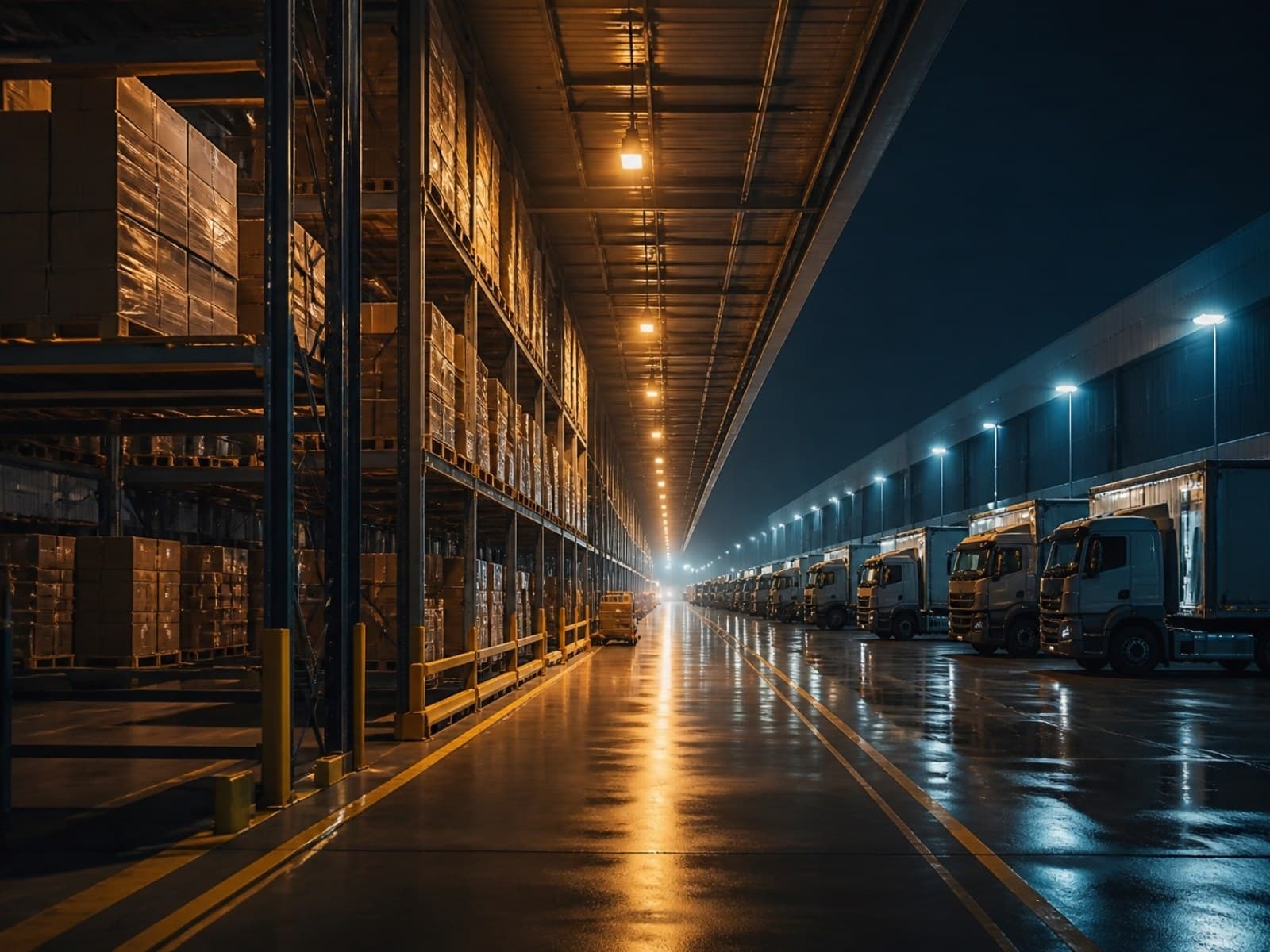
In a warehouse the problem is rarely the goods. It's information that arrives late: the reorder placed when the shelf is already empty, the delivery note retyped with the wrong code, the customer who learns about a delay when the truck doesn't show up. AI for logistics is useful exactly there, getting the right information to you a little earlier. And the idea, you may be surprised to hear, is at least seven hundred years old.
Venice's mude: when the product was the timetable
In the early fourteenth century the Republic of Venice set up a system historians call the mude: convoys of state-owned merchant galleys, built in the Arsenal, which were leased to merchants every year through a public auction, the incanto. Whoever won the auction became the galley's "patron" and sailed it on routes set by the government: toward Alexandria in Egypt, Beirut, Constantinople and the Black Sea, but also westward, as far as Flanders and England. The standard study is Doris Stöckly's Le système de l'Incanto des galées du marché à Venise, covering the late thirteenth to mid-fifteenth century.
Why am I telling you this? Because the value of that system wasn't only in the ships. It was in predictability. The lines were known, the galleys usually left in spring and returned in autumn, and the terms of each voyage were set in advance by the government. A merchant at the Rialto could plan purchases, credit and storage knowing, fairly accurately, when his goods would leave and come back.
Your warehouse sells the same thing today. Customers don't just buy a delivered pallet: they buy the certainty of knowing when it will arrive. And AI, used well, is first of all a predictability tool.
Where AI really helps in logistics and warehousing
Let's set aside robots and fully automated warehouses, which concern a handful of big operators. For a small distributor, a trucking company or a business with its own warehouse, these are the concrete applications.
1. Demand forecasting and reordering
A model that reads sales history, seasonality, promotions and supplier lead times can suggest how much and when to reorder better than a minimum stock level set years ago. Expected result: fewer stockouts on fast movers, less idle stock on slow ones. The final decision stays with the people who know the customers; AI proposes, people approve.
2. Transport documents read automatically
Delivery notes, CMRs, packing lists, order confirmations: they arrive as PDFs, photos, emails. An AI system that reads documents can extract codes, quantities, lots and recipients, compare them with the order and flag only the differences. It's often the first project with a visible return, because it eliminates retyping and catches mistakes before they become returns. More on this in our guide to AI document management.
3. Slotting and picking
By analyzing which items ship together and how often, you can move the most requested products closer to the docks and shorten picking routes. No need to rebuild the warehouse: data from your warehouse management system (WMS) and some discipline in item master data are enough.
4. Delivery route planning
Route optimization tools have been around for a while; AI adds the ability to handle constraints written in plain language ("customer X only receives in the morning", "street Y is closed on market Tuesdays") and to recalculate when something changes.
5. Customers informed before they call
An assistant that answers logistics' most common question, "where's my shipment?", by email, WhatsApp or on the website, reading the status from the system. And that hands everything that isn't a simple status request to a person: complaints, damage, urgent cases.
6. Flagging anomalies
Inventories that don't add up, deliveries consistently late on one route, a supplier who often gets quantities wrong: AI is good at spotting patterns the eye misses, provided someone reviews the alerts and decides what to do.
Practical table: data needed and human checkpoint
| Activity | Data needed | Where a person stays involved |
|---|---|---|
| Forecasting and reordering | Sales history, supplier lead times, stock levels | Approving the purchase order |
| Reading transport documents | Digital delivery notes/CMRs, item master data | Checking flagged differences |
| Slotting and picking | WMS movements, package sizes | Deciding the new layout |
| Delivery routes | Addresses, time windows, vehicles | Confirming the daily plan |
| Shipment status for customers | Tracking, order system | Complaints and non-standard cases |
| Anomalies | Inventories, deliveries, returns | Root-cause analysis and actions |
The middle column matters most. If master data is messy, if item codes change from one supplier to another, if half the movements get recorded "from memory" at the end of the day, no algorithm will work miracles. The first AI project in logistics is very often cleaning up the data.
Before you start: three checks
- Can your system export data? If your WMS or ERP can't extract movements and history in an orderly way, start there.
- Who's in charge? Every automation needs a name: who checks the reorder proposals, who reviews anomalies.
- Is the method clear? Map, measure, prototype on a small slice, keep a person at the right checkpoint: it's the six-step method in our complete guide to business process automation.
A chapter you can't skip: security
The Clusit 2026 report, from Italy's information security association, found that in 2025 the Transport and Logistics sector suffered 12% of the serious cyber incidents recorded in Italy, up 134.6% on the previous year. The reason is intuitive: a warehouse brought down by an attack means idle trucks, idle customers, penalties. Every new connection between your management system, customer portals and AI tools must be protected with personal credentials, two-factor authentication and minimal permissions. And emails asking you to "update the carrier's bank details" must always be verified by phone: we explain why in phishing, AI and cybersecurity for SMBs.
Mistakes to avoid
- Buying the platform before understanding the problem. First measure where time is lost, then pick the tool.
- Trusting forecasts without looking at them. A forecasting model doesn't know your best customer just closed a plant. You do.
- Automating customer replies with no way out. If the assistant can't hand the conversation to a person, angry customers become lost customers.
- Forgetting the warehouse staff. They know why a "theoretical" location doesn't work. Involving them from the start saves months of resistance, as we discuss in AI and work: which tasks change.
A typical scenario
Picture a spare-parts distributor with a few thousand SKUs and twenty employees. Dozens of supplier delivery notes arrive every day in different formats, and a clerk checks them against orders by hand. Step one is having an AI system read the delivery notes and flag only lines with quantity or code differences: the clerk stops retyping and checks exceptions. Step two, a few months later, is using the cleaned-up history to propose reorders on the fastest-moving items. Step three, if it makes sense, is an assistant that answers customers about order status. Three small projects in a row, each measured before moving on. For more complex tasks, where the system must decide which steps to take, you can consider an agent: we explain pros and limits in AI agents: what they are and when you need one.
What to do Monday morning
- Count how many transport documents are handled manually each week and how long checking them takes.
- Export a year of history for your best-selling items and check how many master records have duplicate or incomplete codes.
- Ask whoever answers the phone for the three customer questions that come up most often: they're the first candidates for an assistant.
Want to know where to start in your warehouse?
We work with logistics and distribution companies, always starting from how people work, not from software. Explore our automation services or book a free intro call: in half an hour we'll identify the first information flow worth fixing.
Penzai Magazine
The day's stories, every evening in your inbox
Briefings, guides and analyses from the Penzai Professor: a preview and link for each article, one email a day. Unsubscribe anytime.
Comments
No comments yet. Be the first.